AI halal in Islam is one of the most searched questions as artificial intelligence becomes part of daily life. From ChatGPT and automation tools to medical AI and smart assistants, Muslims are increasingly using intelligent systems for work, learning, and productivity.
Islam encourages innovation but also emphasizes responsibility, ethics, and accountability. This guide explains whether AI is halal, when it becomes haram, and how Muslims can use it wisely.
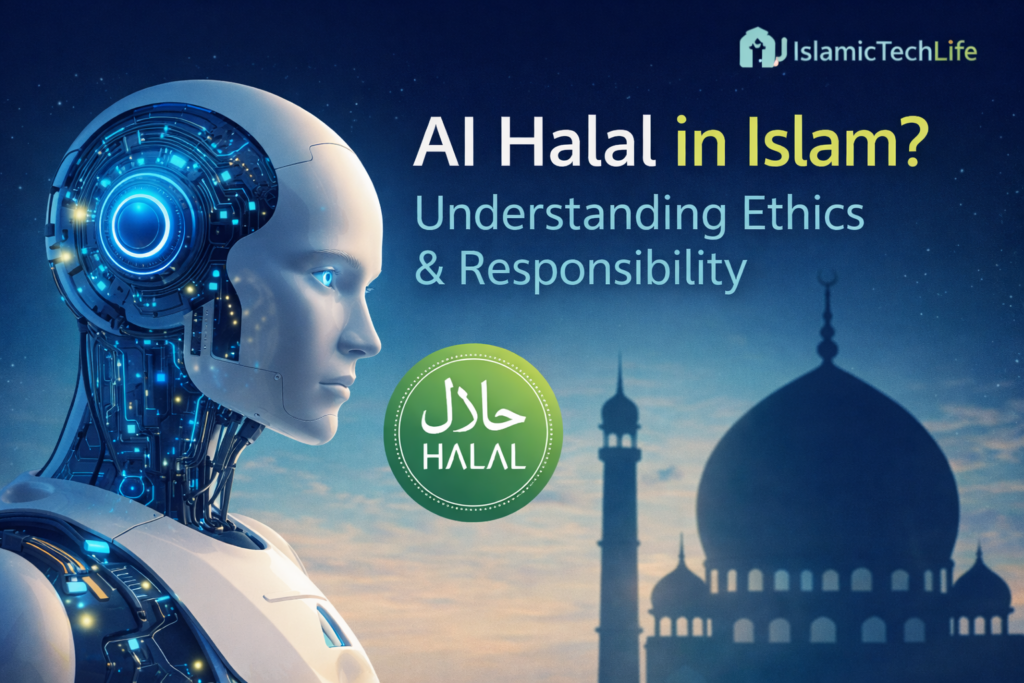
Table of Contents
What Is Artificial Intelligence?
Artificial Intelligence (AI) refers to machines and software that simulate human intelligence such as learning, reasoning, decision-making, and automation. Examples include:
- Chatbots and virtual assistants
- Recommendation systems
- Image generation tools
- Automated trading systems
- Medical diagnosis software
AI itself is a neutral tool. Its ruling depends on usage.
🤖 Why Muslims Are Asking: Is AI Halal in Islam?
As artificial intelligence becomes more visible in everyday life, many Muslims naturally begin asking: is AI halal in Islam or does it carry ethical risks that conflict with Islamic teachings? This question arises because AI is no longer limited to research labs. It is now embedded in mobile phones, workplaces, hospitals, financial platforms, and even educational tools.
The concern about AI halal in Islam is not about fear of technology, but about responsibility. Muslims want to ensure that automation, machine learning, and intelligent systems are not violating Islamic values such as honesty, privacy, dignity, justice, and accountability.
For example, using AI to improve healthcare outcomes, streamline halal businesses, or enhance education aligns with Islamic objectives of benefit and public welfare. However, using AI for deception, surveillance, manipulation, or immoral content clearly raises red flags.
Understanding whether AI halal in Islam depends on context, intention, and impact helps Muslims make confident and informed digital choices rather than blindly adopting or rejecting innovation.
Islamic Principle: Technology Is Permissible by Default
In Islamic jurisprudence, everything is halal unless clearly prohibited. Technology falls under permissible tools as long as:
- It does not promote haram activities
- It does not harm people
- It respects privacy and dignity
- It does not replace obligatory religious duties
Therefore, AI halal in Islam depends on intention and application.
🕌 Scholarly Perspective on Innovation and Human Responsibility
Islam has always encouraged beneficial innovation while maintaining moral accountability. From medical advancements to transportation, Muslims historically embraced new technologies as long as they served humanity and did not violate ethical boundaries. Artificial intelligence follows the same ruling principle.
Scholars explain that tools themselves do not carry moral judgment — human intention and usage determine permissibility. AI systems do not possess free will or moral agency; therefore, responsibility remains entirely with the user, developer, and organization deploying the technology.
This means Muslims must evaluate:
- 🎯 Purpose of usage
- ⚖️ Social impact
- 🔐 Privacy protection
- 📚 Accuracy and reliability
- 🧭 Ethical boundaries
AI cannot replace human conscience, wisdom, or accountability. Muslims should use AI as an assistant — not as an authority or moral decision-maker.
Responsible innovation aligns with the Islamic principle of benefiting humanity while preventing harm.
When Artificial Intelligence Becomes Haram
AI becomes haram if it is used for:
❌ Spreading misinformation or deception
❌ Creating immoral or explicit content
❌ Surveillance, spying, or hacking
❌ Financial fraud or gambling
❌ Replacing human responsibility unfairly
Any technology that causes harm or injustice contradicts Islamic values.
🚨 Real-World Examples of Harmful AI Usage
Understanding theoretical rules is important, but real-world examples help clarify how AI may cross ethical boundaries.
Examples where AI usage becomes problematic include:
- 🕵️ Facial recognition systems used for unethical surveillance
- 🎭 Deepfake technology used for blackmail or misinformation
- 💰 Automated trading bots designed for speculative gambling behavior
- 📊 Data scraping tools violating personal privacy
- 🧠 Manipulative algorithms influencing harmful behavior
- 🎓 Students using AI to cheat instead of learning
These practices contradict Islamic values of justice, honesty, dignity, and accountability. Even if a tool is legally available, it may still be Islamically questionable if it causes harm or injustice.
Muslims should assess not only legality but also ethical consequence before adopting any AI system.
7 Islamic Principles for Using AI Halal in Islam
1. Intention (Niyyah)
Use AI for beneficial purposes such as education, productivity, healthcare, and dawah.
2. Avoid Harm (La Darar)
Do not use AI in ways that harm others financially, emotionally, or spiritually.
3. Truthfulness (Sidq)
Avoid fake content, deepfakes, and plagiarism.
4. Privacy Protection (Amanah)
Do not misuse personal data or violate privacy.
5. Accountability (Hisab)
Humans remain responsible for decisions made using AI.
6. Modesty and Ethics (Akhlaq)
Avoid generating immoral visuals or language.
7. Balance (Wasatiyyah)
Do not allow AI to replace human effort, worship, or relationships.
📘 Practical Scenarios: Applying AI Halal in Islam in Daily Life
Many Muslims wonder how to practically apply the concept of AI halal in Islam in real situations rather than only theoretical discussions. Daily digital activities offer many opportunities where Islamic judgment matters.
🏢 Workplace Usage
Using AI tools for writing assistance, coding, automation, project management, or data analysis is generally permissible when the output remains honest and beneficial. If AI helps increase productivity without deception or harm, then AI halal in Islam applies positively in professional environments.
🎓 Education and Learning
Students using AI to summarize books, organize notes, translate languages, or understand complex topics may benefit greatly. However, cheating, plagiarism, or misrepresentation violates ethical standards. Proper usage keeps AI halal in Islam aligned with integrity and responsibility.
🛒 Business and Entrepreneurship
AI-powered marketing, inventory management, customer service automation, and analytics can strengthen halal businesses. As long as AI does not manipulate consumers, spread false claims, or violate privacy, AI halal in Islam supports ethical entrepreneurship.
🏥 Healthcare and Social Services
AI supporting medical diagnosis, accessibility tools, and patient safety aligns with Islamic values of preserving life and reducing hardship. In such contexts, AI halal in Islam becomes a source of benefit and mercy when governed responsibly.
These real-world examples demonstrate how Muslims can apply Islamic principles practically instead of avoiding technology unnecessarily.
Can Muslims Use ChatGPT and AI Tools?
Yes — if used ethically.
Halal uses include:
✔️ Writing assistance
✔️ Coding and automation
✔️ Research and summarization
✔️ Learning languages
✔️ Business productivity
Avoid copying blindly or using AI for cheating or deception.
Benefits of AI for Muslims
- Saves time and increases productivity
- Improves healthcare and safety
- Enhances education access
- Supports halal business growth
- Enables global collaboration
🌍 AI in Healthcare, Accessibility, and Social Good
Artificial intelligence plays a growing role in healthcare, accessibility, disaster response, and social welfare. AI-powered medical imaging helps doctors detect diseases earlier. Accessibility tools help visually impaired individuals navigate digital platforms. Translation systems allow Islamic knowledge to reach global audiences faster.
For Muslims, these advancements align with Islamic values of preserving life, reducing hardship, and spreading beneficial knowledge.
Examples include:
- 🏥 AI-assisted medical diagnosis
- 🧑🦽 Accessibility tools for disabled users
- 🌍 Multilingual Islamic education platforms
- 🚑 Emergency response optimization
- 📚 Digital preservation of Islamic manuscripts
When used ethically, AI becomes a means of mercy and service rather than exploitation.
Risks Muslims Should Be Aware Of
- Over-dependence on machines
- Privacy breaches
- Ethical misuse
- Job displacement concerns
- Fake content generation
Moderation and awareness are essential.
How AI Can Support Islamic Education and Dawah
Artificial intelligence can be a powerful tool for spreading authentic Islamic knowledge when used responsibly. Scholars, teachers, and students can use AI to summarize classical texts, translate educational material, generate study notes, and organize research efficiently.
Online platforms powered by AI can help Muslims access Quran recitations, tafsir explanations, prayer time reminders, and Arabic learning tools. This improves accessibility for Muslims living in non-Muslim countries or remote areas.
However, users must always verify information from reliable scholars and authentic sources. Blindly trusting AI-generated religious answers can lead to misunderstanding. When guided properly, AI halal in Islam can support education, dawah efforts, and lifelong learning while preserving accuracy and integrity.
🧭 How Muslims Can Stay Safe While Using AI Tools
Practical discipline helps Muslims benefit from AI without crossing ethical boundaries.
Recommended best practices:
- 🔍 Verify information before trusting outputs
- 🔐 Avoid sharing personal or confidential data
- 📚 Cross-check religious content with scholars
- ⚖️ Avoid automating decisions that require human judgment
- 🕰️ Maintain balance and avoid overdependence
- 🤲 Keep intention focused on benefit
AI should support productivity and learning — not replace human responsibility, worship, or relationships.
Digital wisdom protects both faith and privacy.
⚖️ Common Misconceptions About AI Halal in Islam
There are several misunderstandings surrounding the topic of AI halal in Islam that often create unnecessary fear or confusion among Muslims.
One common misconception is that AI replaces human intelligence or decision-making completely. In reality, AI operates based on data and algorithms created by humans. Responsibility always remains with people, not machines. This means AI halal in Islam depends on human intention and ethical boundaries.
Another misconception is that all automation eliminates human jobs and creates injustice. While automation changes job markets, it also creates new opportunities, efficiencies, and industries. Islam encourages adaptation, skill development, and responsible economic transition rather than resisting progress blindly.
Some people fear that AI controls human behavior or has independent consciousness. Current AI does not possess awareness or moral agency. It remains a tool. Therefore, evaluating AI halal in Islam should focus on how humans deploy technology rather than exaggerating technical capabilities.
Clarifying these misconceptions helps Muslims adopt balanced thinking instead of reacting emotionally or based on misinformation.
🌍 Ethical Governance, Regulation, and Muslim Responsibility in AI Development
As artificial intelligence continues to evolve, ethical governance and responsible regulation become increasingly important. Governments, universities, and technology companies are working to establish standards that protect privacy, prevent misuse, and ensure fairness in automated systems. Muslims participating in technology development also carry responsibility to promote justice, transparency, and accountability.
When evaluating AI halal in Islam, it is important to consider not only personal usage but also how systems impact society. Biased algorithms, exploitative data practices, and manipulative automation can harm vulnerable populations. Islam emphasizes justice and preventing harm at both individual and collective levels.
Muslim professionals working in technology fields can contribute positively by designing ethical systems, promoting transparency in data usage, and advocating for user rights. Supporting responsible innovation aligns directly with Islamic principles of protecting dignity and preventing injustice.
Public awareness also plays a role. Users should understand how AI systems collect data, influence decisions, and shape digital behavior. Informed usage strengthens accountability and prevents blind dependence on automation.
By promoting responsible development and informed usage, Muslims help ensure that AI halal in Islam remains aligned with human dignity, social benefit, and spiritual responsibility rather than uncontrolled technological power.
Final Thoughts
AI halal in Islam when used responsibly, ethically, and with beneficial intention. Muslims should embrace innovation while maintaining moral boundaries and accountability.
Technology should serve humanity — not replace values.
According to the World Economic Forum, artificial intelligence is transforming education, healthcare, and business productivity worldwide.
📌 Related Articles
- Is Technology Halal in Islam?
- Halal Content Creation for Muslims
- Online Privacy in Islam
- World Economic Forum