πŸŒ™ Digital Detox in Ramadan: How Muslims Can Reduce Social Media & Focus on Ibadah

Digital detox in Ramadan is becoming essential for Muslims who want to protect their time, focus on ibadah, and reduce social media distractions during the holy month. Ramadan is a sacred time of fasting, reflection, self-discipline, and spiritual renewal. However, in today’s hyper-connected world, many Muslims find themselves struggling with constant notifications, social media scrolling, and digital distractions that steal precious moments meant for worship and reflection.

Ramadan is a sacred month of fasting, reflection, self-discipline, and spiritual renewal. However, in today’s hyper-connected world, many Muslims find themselves struggling with constant notifications, social media scrolling, and digital distractions that steal precious moments meant for worship and reflection.

Practicing a digital detox in Ramadan does not mean abandoning technology completely. Instead, it means using technology mindfully, reducing harmful digital habits, and reclaiming time for Quran, dua, salah, and meaningful family interactions.

This complete guide will help you understand how to reduce social media usage, control screen time, and build healthier digital habits during Ramadanβ€”without disconnecting from necessary work or family communication.
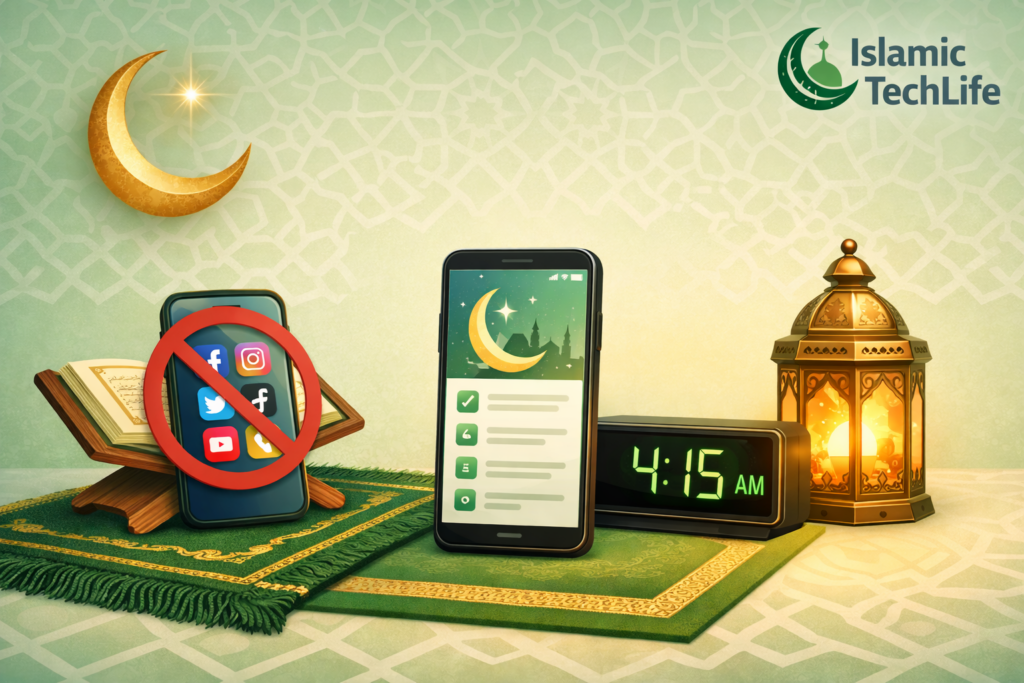
Digital Detox in Ramadan

Table of Contents


🀲 Why Digital Detox in Ramadan Is Important

In Islam, time is an amanah (trust). Ramadan multiplies the rewards of good deeds, but it also magnifies the loss when time is wasted. Endless scrolling, binge-watching, and compulsive phone checking can silently steal hours every day.

Allah reminds us about the value of time in Surah Al-Asr (Quran 103:1–3). The Prophet ο·Ί also said that many people waste two great blessings: health and free time (Sahih Bukhari 6412).

A digital detox in Ramadan helps Muslims:

  • Increase mindfulness in worship
  • Reduce mental clutter and anxiety
  • Improve focus in salah and Quran
  • Create space for reflection and dua
  • Strengthen family and community bonds

πŸ“± How Social Media Affects Spiritual Focus in Ramadan

Social media platforms are designed to keep users hooked. Short videos, notifications, and infinite feeds stimulate dopamine in the brain, making it difficult to disengage. During Ramadan, this constant stimulation weakens khushu (focus) in prayer and reduces the quality of worship.

Common digital challenges during Ramadan include:

  • Checking phones immediately after Iftar
  • Late-night scrolling after Taraweeh
  • Waking up to notifications before Fajr
  • Comparing one’s worship with others online
  • Consuming content that distracts from spiritual goals

A successful digital detox in Ramadan starts with awareness of these patterns.


🧠 The Psychology Behind Digital Addiction

Understanding the psychology of digital addiction helps you control it. Apps are built to exploit human attention through:

  • Infinite scroll
  • Variable rewards (likes, comments)
  • Visual stimulation
  • Instant gratification

When fasting, the brain becomes more sensitive to stimulation. Reducing digital noise allows the mind to settle, improving emotional balance and spiritual presence. This is why a digital detox in Ramadan can feel mentally refreshing and spiritually grounding.


⏰ Practical Digital Detox Plan for Ramadan

A digital detox does not require extreme measures. Small intentional steps can create powerful change.

πŸ”Ή Step 1: Set Clear Digital Boundaries

  • Turn off non-essential notifications
  • Remove social media apps temporarily
  • Use app timers to limit usage
  • Avoid phone usage during prayer times

πŸ”Ή Step 2: Create Phone-Free Zones

  • No phone during Iftar
  • No phone during Quran reading
  • No phone in the masjid
  • No phone 30 minutes before sleep

πŸ”Ή Step 3: Replace Screen Time with Ibadah

  • Read Quran when tempted to scroll
  • Make dhikr during waiting times
  • Listen to Islamic lectures instead of entertainment
  • Reflect quietly after prayers

These steps help establish a sustainable digital detox in Ramadan.


πŸ•Œ Using Technology Positively During Ramadan

Islam does not reject technology. The goal is to use it intentionally.

Productive Digital Tools:

  • Quran apps with daily recitation goals
  • Prayer time reminders
  • Online tafsir lectures
  • Charity donation platforms
  • Ramadan planners

When used wisely, technology can enhance your Ramadan instead of distracting from it.


πŸ‘¨β€πŸ‘©β€πŸ‘§ Family Digital Detox in Ramadan

Digital habits affect the entire household. Ramadan is an ideal time to create a spiritually focused family environment.

Family Detox Tips:

  • Phone-free Iftar table
  • Shared Quran reading sessions
  • Family dua time
  • Reduced TV usage
  • Encouraging children to reduce screen time

A collective digital detox in Ramadan strengthens family bonds and builds healthy long-term habits.


πŸ§‘β€πŸŽ“ Digital Detox for Students in Ramadan

Students often face the challenge of online learning, exams, and social media pressure during Ramadan.

Tips:

  • Study in focused time blocks
  • Avoid social media between study sessions
  • Use productivity apps instead of entertainment apps
  • Replace late-night scrolling with revision or reflection

This approach helps students maintain a balanced digital detox in Ramadan while meeting academic goals.


πŸ’Ό Digital Detox for Working Professionals

Professionals can practice digital detox without harming productivity:

  • Check emails at fixed intervals
  • Avoid unnecessary meetings
  • Reduce WhatsApp group noise
  • Take short breaks for prayer instead of scrolling

Work performed with intention becomes worship during Ramadan.


βš–οΈ Common Mistakes During Digital Detox

  • Going extreme and quitting all communication
  • Feeling guilty for necessary work usage
  • Replacing social media with excessive TV
  • Not setting realistic goals

Balance is key to a successful digital detox in Ramadan.


πŸ“… 7-Day Digital Detox Challenge (Ramadan Friendly)

Day 1: Track your screen time
Day 2: Remove one distracting app
Day 3: Phone-free Iftar
Day 4: No social media after Maghrib
Day 5: Quran before phone
Day 6: Silent notifications during prayers
Day 7: Reflection and reset

This challenge helps you gradually implement a digital detox in Ramadan.


🌱 Long-Term Benefits of Digital Detox in Ramadan

  • Improved concentration
  • Better sleep quality
  • Stronger spiritual presence
  • Reduced anxiety
  • Healthier digital habits
  • Increased quality family time

These benefits often continue long after Ramadan ends.


🧭 Life After Ramadan: Sustaining Digital Balance

The purpose of Ramadan is transformation. Continue these habits:

  • Set daily screen limits
  • Protect prayer times from distractions
  • Maintain Quran reading routines
  • Practice weekly digital detox hours

A balanced digital lifestyle aligns with Islamic values.


🌍 Real-Life Examples of Digital Detox in Ramadan

Understanding the concept of digital detox in Ramadan becomes easier when we observe real-life situations. Many Muslims struggle silently with excessive screen time without realizing how much spiritual opportunity is lost daily.

πŸ‘¨β€πŸ’Ό Example 1: A Working Professional

A working professional spends most of the day on emails, WhatsApp messages, and online meetings. During Ramadan, he decides to practice digital boundaries by checking emails at fixed times, muting unnecessary WhatsApp groups, and avoiding social media after Iftar. Over time, he finds more peace of mind, improved focus in salah, and greater presence during family Iftar.

πŸŽ“ Example 2: A Student Preparing for Exams

A student fasting while studying faces fatigue and digital distraction. By reducing social media usage and replacing scrolling with Quran recitation during breaks, the student finds that concentration improves. This balanced approach shows that digital detox in Ramadan does not mean quitting technology but using it intentionally.

🏑 Example 3: A Family Practicing Collective Detox

A family decides to keep phones away from the dining table during Iftar and after Maghrib. They pray together, share reflections, and read Quran as a family. This collective digital discipline strengthens family bonds and creates a spiritually nourishing home environment.


🧠 Spiritual & Mental Benefits of Digital Detox in Ramadan

Beyond productivity, a digital detox in Ramadan brings significant mental health benefits. Constant digital stimulation overloads the brain and reduces emotional resilience. When Muslims reduce screen exposure, the mind experiences calmness and clarity.

Fasting already trains self-control. Combining fasting with controlled digital usage strengthens patience, mindfulness, and emotional regulation. Many people report better sleep quality, reduced anxiety, and increased spiritual satisfaction when they reduce nighttime scrolling during Ramadan.


πŸ“… Creating a Personal Digital Detox Plan for Ramadan

A simple personal plan makes digital detox sustainable:

  • Identify top distracting apps
  • Set daily screen-time limits
  • Designate phone-free worship time
  • Schedule digital-free periods after Maghrib
  • Reflect weekly on progress

Consistency is more important than perfection. Even reducing digital consumption by 30–40% during Ramadan can bring noticeable improvements in spiritual focus.


βš–οΈ Balancing Technology Without Guilt

Islam does not discourage beneficial technology. The goal of digital detox in Ramadan is not rejection of modern tools but mastery over them. Using technology for work, learning, and family communication is permissible and often necessary. The key is intentionalityβ€”ensuring that technology serves your values rather than controlling your time.


🌱 Carrying Digital Detox Habits Beyond Ramadan

The real success of digital detox in Ramadan appears after Ramadan ends. Habits such as controlled screen time, mindful content consumption, and protected prayer moments can become permanent lifestyle changes. Ramadan becomes a training ground for digital discipline that continues throughout the year.


🧩 Common Digital Distractions That Ruin Focus in Ramadan

Many Muslims start Ramadan with good intentions but unknowingly fall into common digital traps that slowly reduce spiritual focus. Recognizing these distractions is the first step toward practicing a meaningful digital detox in Ramadan.

One of the biggest distractions is endless short-form video content. Platforms like Instagram Reels, YouTube Shorts, and TikTok are designed to keep users scrolling without realizing how much time has passed. During Ramadan, this habit can silently consume the most spiritually valuable moments of the dayβ€”especially after Iftar and before sleep.

Another major distraction is constant message checking. Family WhatsApp groups, office chats, and community announcements can create notification overload. While communication is important, frequent interruptions break concentration during prayer, Quran recitation, and reflection. Muting non-essential groups during worship times can significantly improve focus.

Late-night screen usage is another hidden productivity killer. Many people scroll their phones after Taraweeh, which delays sleep and reduces energy for Suhoor and Fajr. Poor sleep patterns weaken both physical stamina and spiritual presence. Practicing a digital detox in Ramadan includes setting a clear boundary for night-time phone usage to protect rest and worship quality.


πŸ› οΈ Practical Tools to Support Digital Detox in Ramadan

Digital detox does not mean avoiding technology completely. In fact, certain tools can help Muslims control digital habits more effectively during Ramadan.

Smartphone features such as screen time limits, focus mode, and do-not-disturb settings allow users to block distracting apps during specific hours. For example, you can schedule social media restrictions during Maghrib to Isha time so your evenings remain spiritually focused.

Another helpful practice is using intentional reminders. Setting gentle alarms for prayer, Quran reading, or reflection helps replace unconscious scrolling with purposeful action. Some Muslims also find it helpful to place physical remindersβ€”such as keeping the phone in another room during worshipβ€”to create psychological distance from distractions.

Replacing digital habits with meaningful alternatives is equally important. Keeping a Quran or dua book nearby makes it easier to choose remembrance over scrolling. These small environmental changes play a powerful role in sustaining a successful digital detox in Ramadan.


🀝 Community Support for Digital Detox During Ramadan

Spiritual growth becomes easier when supported by community. Practicing digital detox in Ramadan as a group creates accountability and motivation. Families, friends, or masjid groups can collectively agree on simple detox practices such as phone-free Iftar, reduced social media use, or shared Quran reading sessions.

Community challengesβ€”like β€œNo Social Media After Maghrib” or β€œOne Hour Screen-Free Daily”—create positive peer pressure. When people see others making the effort, they feel encouraged to stay committed. Online Muslim communities can also promote mindful technology use by sharing beneficial reminders instead of distractions.

Ramadan is not meant to be a solitary journey. Supporting each other in reducing digital distractions strengthens collective spiritual energy and fosters a healthier digital culture within the Muslim community.


πŸŒ™ Reflective Practice: Turning Digital Silence into Spiritual Presence

A key element of digital detox in Ramadan is learning to embrace moments of silence. When phones are put away, the initial feeling of restlessness is natural. Over time, however, silence becomes a space for reflection, gratitude, and deeper connection with Allah.

Use quiet moments to engage in self-reflection. Ask yourself:

  • How did I spend my time today?
  • Did my digital habits support my spiritual goals?
  • What small change can I make tomorrow?

This reflective practice transforms digital silence into spiritual presence. Instead of filling every moment with content consumption, Muslims learn to fill their hearts with remembrance. This shift in mindset is one of the most powerful long-term outcomes of practicing digital detox in Ramadan.


🏁 Closing Reflection

Ramadan is a rare spiritual opportunity. When distractions are reduced, the heart becomes more receptive to remembrance of Allah. A sincere digital detox in Ramadan is not about becoming disconnected from the world, but about reconnecting with your soul, your purpose, and your Creator.


πŸŒ™ Ramadan Routine for Busy Professionals: 9 Powerful Habits to Balance Work, Worship & Family

Ramadan is a blessed month of fasting, self-discipline, reflection, and increased worship. For many Muslims, it is the most spiritually meaningful time of the year. Ramadan routine for busy professionals is essential for Muslims who want to balance demanding work schedules with fasting, worship, and family responsibilities during the holy month. Long working hours, office deadlines, commuting, family responsibilities, and constant digital distractions make it difficult to maintain consistency in worship and self-care.

Many working Muslims begin Ramadan with strong intentions to pray more, read Quran daily, attend Taraweeh regularly, and improve their character. But as the days pass, fatigue, poor sleep, work pressure, and digital overload often take over. The result is burnout, missed prayers, irregular Quran reading, and a sense of spiritual regret.

This is where creating a structured Ramadan routine for busy professionals becomes essential. A well-planned routine does not require perfection or unrealistic schedules. Instead, it focuses on small, consistent habits that fit into your existing work life. When you design your day with intention, your work becomes more focused, your worship becomes more meaningful, and your Ramadan becomes more fulfilling.

This complete guide will help you build a practical Ramadan routine that allows you to balance work, fasting, worship, family life, rest, and digital disciplineβ€”without overwhelming yourself.

Ramadan routine for busy professionals


🀲 Why Busy Professionals Need a Ramadan Routine

In Islam, consistency is beloved by Allah, even if the deeds are small. A clear routine protects your time and energy during Ramadan. Without a routine, days become reactive. You wake up tired, rush to work, skip planned worship, overwork yourself, and then feel too exhausted at night to pray Taraweeh with focus.

A well-structured Ramadan routine for busy professionals helps you:

  • Protect prayer times during busy workdays
  • Create daily space for Quran recitation
  • Manage fasting energy levels wisely
  • Reduce digital distractions and mindless scrolling
  • Maintain family relationships
  • Avoid burnout and spiritual fatigue

Rather than feeling guilty about what you couldn’t do, a routine helps you feel content with what you did consistently.


⏰ Designing a Practical Ramadan Daily Schedule

A structured ramadan routine for busy professionals helps reduce decision fatigue and brings clarity to daily priorities.

Your Ramadan schedule should be realistic, flexible, and aligned with your work hours. Below is a simple structure you can adapt to your lifestyle.

πŸŒ„ Pre-Fajr: Spiritual Start of the Day

The early hours of Ramadan are full of barakah. Even a short spiritual start can set the tone for the entire day.

  • Wake up 30–45 minutes before Fajr
  • Eat a light and nourishing Suhoor
  • Pray Fajr with focus
  • Read 5–10 minutes of Quran
  • Make intention (niyyah) for the day

Starting your day with worship grounds your mindset before work pressure begins.


🧠 Morning Work Block: High Focus Window

After Fajr, the mind is often at its clearest. Use this time for important work.

  • Handle complex tasks early in the day
  • Avoid unnecessary meetings if possible
  • Break big tasks into small achievable steps
  • Minimize notifications and email checking

This focused work block increases productivity and reduces stress later in the day.


πŸ•Œ Midday Reset: Short Spiritual Pause

During lunch hours, fasting professionals often feel mentally drained. Instead of scrolling your phone, use this time for a short reset.

  • Pray Zuhr on time
  • Sit quietly for a few minutes
  • Make short dua
  • Take a 10–15 minute rest (Qailulah)

This pause refreshes your mental energy and renews your spiritual intention.


🧾 Afternoon Work: Low-Energy Tasks

Energy levels usually dip in the afternoon while fasting. This is a good time for lighter tasks.

  • Respond to emails
  • Organize your work for the next day
  • Complete simple administrative work
  • Avoid heavy decision-making

Accepting lower energy levels helps prevent burnout.


πŸŒ™ Evening: Iftar, Family & Presence

Iftar is not just about eatingβ€”it is a spiritual moment.

  • Break fast with dates and water
  • Pray Maghrib on time
  • Eat moderately
  • Spend a few minutes in gratitude
  • Avoid using your phone during Iftar

Being present with family at Iftar strengthens relationships and increases barakah in your home.


πŸŒƒ Night: Worship & Recovery

Night worship is central to Ramadan, but it should not come at the cost of complete exhaustion.

  • Pray Isha and Taraweeh
  • Read a small portion of Quran
  • Make dua
  • Sleep early enough to protect Suhoor and Fajr

Consistency matters more than praying long hours once and burning out the next day.


πŸ“΅ Digital Discipline for Busy Professionals in Ramadan

Without a clear ramadan routine for busy professionals, digital distractions and work pressure can easily consume valuable Ramadan time.

Digital distractions silently steal valuable Ramadan time. Many professionals unintentionally spend hours on social media after Iftar or before sleep, which affects energy levels and worship quality.

Practical digital habits:

  • Turn off non-essential notifications
  • Avoid social media before Fajr and after Taraweeh
  • Use focus mode during work
  • Replace scrolling with short Quran reading
  • Keep your phone away during Iftar and prayer

A disciplined digital life strengthens your Ramadan routine for busy professionals by protecting both time and mental clarity.


🧘 Managing Energy While Fasting at Work

Fasting affects concentration, mood, and physical stamina. Instead of fighting your body, work with your energy levels.

  • Drink enough water between Maghrib and Fajr
  • Eat balanced Suhoor (protein + complex carbs)
  • Avoid heavy fried foods at Iftar
  • Take short walks to stay alert
  • Avoid excessive caffeine at night

Productivity during Ramadan is not about doing moreβ€”it is about doing what matters with clarity.


πŸ‘¨β€πŸ‘©β€πŸ‘§ Balancing Family, Work & Worship

Creating a flexible ramadan routine for busy professionals allows working Muslims to honor both career responsibilities and spiritual goals.

Busy professionals often feel torn between career demands and family responsibilities during Ramadan. Balance is possible with intentional planning.

  • Share Iftar responsibilities
  • Pray together when possible
  • Read Quran with children
  • Reduce television and phone usage at home
  • Create a calm spiritual environment

When family life supports worship, your Ramadan routine becomes sustainable.


❌ Common Mistakes Busy Professionals Make in Ramadan

Many professionals unintentionally sabotage their Ramadan routine. Common mistakes include:

  • Skipping Suhoor
  • Staying up late on social media
  • Overworking despite low energy
  • Setting unrealistic worship goals
  • Ignoring rest and sleep
  • Comparing your worship to others

Avoiding these mistakes allows your Ramadan routine to remain balanced and achievable.


πŸ“… Weekly Planning Framework for Ramadan

A weekly structure prevents you from feeling lost as the days pass.

Week 1: Foundation

  • Adjust sleep schedule
  • Set simple spiritual goals
  • Reduce social media usage

Week 2: Consistency

  • Maintain daily Quran reading
  • Protect prayer times
  • Stabilize work routine

Week 3: Growth

  • Increase night prayers
  • Add extra charity
  • Strengthen digital discipline

Week 4: Reflection

  • Focus on forgiveness
  • Reflect on habits to continue
  • Prepare for post-Ramadan life

🌱 Carrying Ramadan Habits Beyond the Month

The real success of a Ramadan routine for busy professionals is seen after Ramadan ends. The habits you buildβ€”early waking, mindful digital usage, consistent prayerβ€”can transform your entire year.

Carry forward:

  • Controlled screen time
  • Daily Quran reading
  • Prayer on time
  • Intentional work habits
  • Weekly spiritual reflection

Ramadan becomes a training ground for lifelong balance.


🧩 Real-World Challenges Busy Professionals Face During Ramadan

For many working Muslims, Ramadan brings a unique set of challenges that go beyond fasting. The combination of long office hours, commuting stress, family obligations, and constant digital notifications can make it difficult to maintain spiritual focus. Many professionals feel mentally drained by the afternoon, which affects both work performance and worship consistency.

One common challenge is mental fatigue. Fasting can lower energy levels, especially for those who work in demanding environments such as IT, healthcare, finance, or sales. Without proper rest and hydration planning, professionals may feel irritable, unfocused, or demotivated. Recognizing this reality helps in building a compassionate and realistic Ramadan routine instead of setting unrealistic expectations.

Another major challenge is time scarcity. Busy professionals often feel that there is β€œno time” for Quran, reflection, or dua. However, the issue is rarely the lack of timeβ€”it is the lack of intentional time use. Small pockets of time, such as during commutes, short breaks, or waiting periods, can be transformed into moments of remembrance when used consciously.


🧠 Building Mental Resilience During Ramadan Workdays

Mental resilience is a key part of sustaining a healthy Ramadan routine. Working while fasting requires patience, emotional control, and adaptability. One effective method is to reframe fasting as a source of strength rather than limitation. When professionals view fasting as a form of spiritual training, daily work challenges feel more meaningful and manageable.

Practicing brief moments of mindfulness during the day can help restore mental clarity. Taking two minutes to breathe deeply, make silent dhikr, or set a small intention before starting a task can reset your focus. These micro-practices accumulate into a calmer and more spiritually aware workday.

Another helpful strategy is reducing decision fatigue. Planning meals, outfits, and work priorities in advance reduces mental load during fasting hours. When fewer daily decisions demand your energy, you preserve mental strength for both work and worship.


🏑 Creating a Supportive Home Environment for Ramadan Success

A professional’s Ramadan routine is strongly influenced by the home environment. When the household is chaotic or digitally noisy, it becomes harder to maintain spiritual focus. Creating a calm and supportive environment helps everyone in the family benefit from Ramadan.

Simple steps include preparing Iftar ingredients in advance, sharing responsibilities, and setting shared family goals for worship. When family members support each other, the burden on one individual is reduced. A supportive home environment allows busy professionals to return from work and enter a space that encourages reflection rather than distraction.

Reducing television usage during Ramadan evenings also plays an important role. Background noise and entertainment can dilute the spiritual atmosphere of the home. By intentionally creating quieter evenings, families can reconnect with each other and with the spiritual essence of Ramadan.


βš–οΈ Balancing Career Ambitions With Spiritual Intentions

Many professionals worry that focusing on worship during Ramadan may reduce career productivity. Islam, however, encourages balance rather than neglect. Working with sincerity, fulfilling responsibilities, and maintaining ethical conduct are acts of worship when done with the right intention.

Rather than viewing career and spirituality as competing forces, integrate them. Begin work with a silent intention that your efforts are for halal provision and service. Maintain honesty, patience, and kindness in professional interactions. This alignment of intention transforms everyday work into spiritually meaningful activity.

Professionals who adopt this mindset often experience less inner conflict. Instead of feeling guilty for working, they see their work as part of their worship when carried out ethically and mindfully.


πŸ“– Small Spiritual Habits That Fit Into Busy Workdays

Sustainable Ramadan routines rely on small, repeatable habits rather than dramatic changes. Busy professionals can benefit from simple practices such as:

  • Listening to Quran recitation during commutes
  • Reading a few verses during short breaks
  • Making silent dhikr while walking between meetings
  • Reciting short duas before starting tasks
  • Reflecting briefly before sleeping

These habits require minimal time but create a consistent spiritual rhythm throughout the day. Over the course of Ramadan, these small acts accumulate into meaningful spiritual growth.


🌱 Turning Ramadan Into a Long-Term Lifestyle Reset

Ramadan should not be seen as a one-month spiritual sprint. For busy professionals, it can serve as a powerful lifestyle reset. The discipline developed through fasting, time management, and digital restraint can reshape daily routines long after Ramadan ends.

By consciously observing which habits improved focus, calmness, and productivity during Ramadan, professionals can choose to carry forward the most beneficial ones. This might include waking up earlier, limiting screen time at night, planning workdays more intentionally, or maintaining regular Quran reading.

When Ramadan becomes a training ground rather than a temporary phase, its impact extends far beyond thirty days. The goal is not to maintain peak productivity forever, but to build a healthier balance between work, worship, rest, and personal growth.


🏁 Reflection for Busy Professionals

Ramadan offers busy professionals a rare opportunity to slow down internally even when life remains externally fast-paced. By embracing small changes, realistic routines, and intentional living, professionals can experience Ramadan not as a burden, but as a source of renewal. Each small effort counts, and consistencyβ€”no matter how modestβ€”builds lasting spiritual strength.


🏁 Final Thoughts

Ultimately, a sustainable ramadan routine for busy professionals is about consistency, intention, and balance rather than perfection.

Ramadan is not about becoming perfectβ€”it is about becoming intentional. A practical Ramadan routine for busy professionals helps you balance work, worship, family, and self-care without burning out. When your days are aligned with purpose, even your work becomes an act of worship.

May Allah grant you ease, acceptance, and barakah in your time this Ramadan. 🀲


Digital Detox in Ramadan
Ramzan Productivity for Muslims

πŸ‘‰ Surah Al-Asr (Quran 103)
Allah reminds us about the value of time in Surah Al-Asr (Quran 103), highlighting the importance of using our days wisely.

πŸ‘‰ Sahih Bukhari 6412
The Prophet ο·Ί warned that many people waste two great blessingsβ€”health and free timeβ€”as mentioned in Sahih Bukhari 6412.


πŸŒ™ Ramadan Sleep Schedule for Muslims: Fix Your Routine Without Burnout

Ramadan changes the rhythm of daily life for Muslims around the world. Late-night Taraweeh prayers, early Suhoor and Fajr, long fasting hours, work or studies, and family commitments all come together to disrupt normal sleep patterns. Many people begin Ramadan motivated and spiritually energized, but within a few days they feel exhausted, sleepy during the day, and mentally foggy. Over time, this lack of rest starts affecting prayer focus, productivity at work, patience with family, and even physical health.

A healthy Ramadan sleep schedule for Muslims is not about sleeping perfectly or following a strict timetable. It is about building a realistic routine that respects the unique rhythm of Ramadan while protecting your energy and mental clarity. When sleep is neglected, worship can become heavy and daily responsibilities feel overwhelming. When sleep is managed well, fasting becomes easier, prayers feel lighter, and Ramadan becomes a month of spiritual renewal rather than physical burnout.

This practical guide breaks down how to structure your nights and days, how to use naps wisely, how to balance Taraweeh with rest, how to manage digital distractions, and how to build a sustainable sleep routine that fits working professionals, students, and families.

Ramadan Sleep Schedule for Muslims Fix Your Routine Without Burnout


🀲 Why Sleep Matters in Ramadan

Islam teaches balance. The body is an amanah (trust) from Allah, and taking care of it is part of worship. Sleep deprivation weakens the immune system, reduces concentration, increases irritability, and makes self-control harder. During Ramadan, when fasting already challenges the body, lack of sleep multiplies the difficulty.

When sleep is poor in Ramadan, common problems include:

  • Struggling to wake up for Suhoor and Fajr
  • Feeling sleepy during prayers
  • Low energy and focus at work or studies
  • Increased irritability and mood swings
  • Headaches and dehydration
  • Burnout halfway through the month

A balanced Ramadan routine protects both your body and your worship.


🧠 How Poor Sleep Affects Worship, Work, and Relationships in Ramadan

Sleep is not just about physical rest; it deeply affects how we think, feel, and behave. During Ramadan, when fasting already challenges the body, poor sleep can amplify every small difficulty. Many Muslims notice that when they are sleep-deprived, they struggle to focus in salah, become impatient with family members, and feel mentally drained at work. This creates a negative cycle where tiredness leads to frustration, and frustration reduces the quality of worship.

From a spiritual perspective, sleep deprivation weakens khushu (presence of heart) in prayer. When the mind is foggy, it becomes harder to reflect on Quranic verses or remain mindful during dua. Even Taraweeh, which should feel spiritually uplifting, can start to feel physically heavy when the body is exhausted. Over time, this can reduce motivation and make Ramadan feel like a burden rather than a blessing.

At work or during studies, lack of sleep affects concentration, memory, and decision-making. Tasks take longer to complete, small mistakes increase, and overall productivity drops. This can lead to added stress and self-criticism, especially for professionals who already feel pressure to perform at their best during Ramadan. When work feels overwhelming, it becomes harder to maintain patience and emotional balance.

Relationships are also impacted by poor sleep. Fatigue lowers emotional resilience, making people more irritable and sensitive to small issues. Family conversations can turn tense, and minor disagreements can escalate quickly. Ramadan is meant to be a time of mercy, patience, and kindness, but without sufficient rest, even well-intentioned people can struggle to embody these values consistently.

Recognizing these effects helps Muslims take sleep more seriously as part of their Ramadan routine. When sleep is prioritized, worship feels lighter, work becomes more manageable, and relationships become calmer. Protecting rest is not selfish; it is a way of protecting the quality of your worship and your character during the holy month.


πŸ› οΈ Practical Sleep Planning for Different Lifestyles in Ramadan

Not everyone experiences Ramadan in the same way. Work schedules, family responsibilities, and personal energy levels vary widely. Creating a flexible sleep plan based on your lifestyle helps you avoid unrealistic expectations.

πŸ‘¨β€πŸ’Ό For Full-Time Working Professionals

Many professionals have fixed office hours and long commutes. For them, protecting night sleep is critical. Aim to go to bed soon after Taraweeh and avoid late-night social media. If possible, take a short nap during lunch breaks or after returning home from work. Even 20 minutes of rest can restore mental clarity. Preparing work priorities the night before also reduces morning stress and mental fatigue.

πŸŽ“ For Students

Students often stay up late studying or socializing after Iftar. While Ramadan may seem like a flexible time, irregular sleep quickly leads to exhaustion. Studying after Fajr, when the mind is fresh, can be more effective than late-night study sessions. Short daytime naps can help maintain focus without affecting night sleep.

🏑 For Homemakers and Parents

Homemakers and parents often experience broken sleep due to childcare responsibilities. Planning Iftar preparations earlier in the day and sharing responsibilities with family members can free up some evening time for rest. Even brief moments of rest throughout the day can make a significant difference in energy levels.

By tailoring your sleep plan to your lifestyle, you create a routine that is realistic and sustainable throughout Ramadan.


⏰ How Ramadan Naturally Disrupts Your Sleep

Ramadan shifts the daily schedule in multiple ways:

  • Meals move to night-time
  • Taraweeh extends the evening
  • Suhoor and Fajr require early wake-ups
  • Social and family gatherings often happen late
  • Screen time increases at night

Because of this, many Muslims experience fragmented sleep instead of one long night of rest. This is normal. The goal is not to force a normal sleep pattern, but to design a Ramadan sleep schedule for Muslims that works with this reality.


πŸŒƒ 1️⃣ Set a Fixed Night Routine (Protect Your Bedtime)

One of the biggest mistakes in Ramadan is letting bedtime drift later every night.

What to do:

  • Choose a realistic bedtime after Taraweeh
  • Aim to be in bed within 30–45 minutes after prayers
  • Avoid starting movies or long chats at night
  • Create a calming wind-down routine (dim lights, quiet time)

Why it helps:
A consistent bedtime trains your body clock, making it easier to fall asleep quickly and wake up for Suhoor without struggle.


πŸ“΅ 2️⃣ Control Night-Time Screen Usage

Late-night scrolling is one of the biggest sleep killers.

Fix this by:

  • No phone use in bed
  • Set β€œDo Not Disturb” after Taraweeh
  • Use night mode on devices
  • Replace scrolling with Quran reading or reflection

Why it helps:
Screens delay sleep and overstimulate the brain, reducing sleep quality.


πŸŒ„ 3️⃣ Smart Pre-Fajr Routine (Don’t Kill Your Sleep)

Many people wake up for Suhoor and then stay awake scrolling, losing precious sleep.

Better routine:

  • Wake up for Suhoor
  • Eat light and hydrate
  • Pray Fajr
  • Go back to sleep if possible

Why it helps:
Split sleep is normal in Ramadan and helps preserve total rest.


😴 4️⃣ Use Power Naps the Right Way

Short naps can save your energy.

Best nap practice:

  • 20–40 minutes after Zuhr
  • Avoid long naps after Asr
  • Nap in a quiet, dark space

Why it helps:
Power naps restore focus without ruining night sleep.


πŸ•Œ 5️⃣ Balance Taraweeh With Physical Recovery

Taraweeh is important, but not at the cost of total exhaustion.

Healthy approach:

  • Pray consistently, not excessively
  • Choose mosque or home based on energy
  • Focus on quality, not length
  • Don’t feel guilty for shorter prayers

Why it helps:
Sustainable worship is better than burning out.


πŸ§‘β€πŸ’Ό 6️⃣ Sleep Tips for Working Professionals

For office workers:

  • Do complex work in the morning
  • Keep afternoons for light tasks
  • Take short movement breaks
  • Stay hydrated at night

For night-shift workers:

  • Sleep in dark rooms during the day
  • Use eye masks and earplugs
  • Maintain Suhoor + Fajr routine

πŸŽ“ 7️⃣ Sleep Tips for Students

Students should:

  • Study after Fajr when the mind is fresh
  • Avoid late-night study marathons
  • Use short focused study blocks
  • Nap briefly in the afternoon

πŸ₯— 8️⃣ Eat & Drink for Better Sleep

Avoid:

  • Heavy fried foods at Iftar
  • Caffeine after Maghrib
  • Sugary desserts late at night

Prefer:

  • Light Iftar
  • Balanced Suhoor (protein + complex carbs)
  • Water between Maghrib and Fajr

🏑 9️⃣ Create a Sleep-Friendly Bedroom

Improve your sleep environment:

  • Dim lights
  • Cool temperature
  • Quiet room
  • Comfortable bedding
  • Phone away from bed

❌ Common Ramadan Sleep Mistakes

  • Sleeping too late every night
  • Skipping naps completely
  • Overeating at Iftar
  • Using caffeine to survive the day
  • Doomscrolling at night
  • Comparing your routine to others

πŸ“… Sample Ramadan Sleep Schedules

Working Professional:

  • Sleep: 11:30 PM
  • Wake: 4:30 AM (Suhoor + Fajr)
  • Back to sleep: 45–60 mins
  • Nap: 20–30 mins after Zuhr

Student:

  • Sleep: 12:00 AM
  • Wake: 4:30 AM
  • Study after Fajr
  • Nap: Afternoon

Homemaker:

  • Sleep after Taraweeh
  • Short rest after Fajr
  • Midday nap

🌱 How to Maintain Sleep Health After Ramadan

  • Reduce night-time screen use
  • Maintain consistent bedtime
  • Keep short naps if needed
  • Balance meals
  • Protect prayer + sleep times

🌿 Building a Calm Night Routine to Improve Sleep Quality in Ramadan

A calm night routine signals to the body that it is time to rest. Without a clear transition from activity to rest, the mind remains overstimulated, making it difficult to fall asleep. During Ramadan, nights are often busy with prayers, family gatherings, and digital engagement, which can delay this transition.

Creating a simple wind-down routine after Isha and Taraweeh can greatly improve sleep quality. This may include dimming the lights, reducing noise, performing short dhikr, or reading a few verses of Quran quietly. These actions help the nervous system relax and prepare for sleep. Avoiding stimulating content such as intense videos or social media arguments before bed also supports deeper rest.

Physical cues also play a role in improving sleep. Washing your face with cool water, changing into comfortable sleepwear, and keeping the bedroom environment calm and tidy can help the body associate these actions with rest. Consistency is key. When the same routine is followed each night, the body begins to naturally feel sleepy at the right time.


πŸ“… Weekly Sleep Reset: How to Adjust Your Routine Gradually

Trying to change your sleep routine overnight often leads to failure. A gradual approach works better, especially during Ramadan.

Week 1: Awareness and Small Adjustments

Track your current sleep habits. Note what time you go to bed, how long you sleep, and how you feel during the day. Make one small change, such as reducing screen time before bed by 15 minutes.

Week 2: Strengthening Consistency

Choose a fixed bedtime window and aim to follow it most nights. Introduce short daytime naps if needed and reduce caffeine intake after Maghrib.

Week 3: Deepening Rest

Focus on improving sleep quality by optimizing your bedroom environment and night routine. This may include dimming lights earlier, keeping phones away from the bed, and practicing short moments of reflection before sleep.

Week 4: Reflection and Maintenance

Reflect on what changes helped you feel more rested. Commit to maintaining these habits for the remainder of Ramadan and beyond. This reflection phase helps transform temporary adjustments into long-term healthy habits.


πŸŒ™ Using Reflection to Prevent Burnout During Ramadan

Burnout often happens when people push themselves too hard without listening to their body. Regular reflection helps prevent this. Taking a few minutes each night to ask yourself how your energy levels were during the day can guide small adjustments in your routine. If you felt constantly exhausted, it may be a sign that you need earlier bedtimes, lighter evening activities, or shorter Taraweeh sessions.

Reflection also helps align expectations with reality. Ramadan is not about maximizing output at the cost of health. It is about consistent, sincere effort. When you treat rest as part of worship, you reduce guilt and build a healthier relationship with your body and spiritual goals.


🏁 Final Thoughts

A healthy Ramadan sleep schedule for Muslims is not about perfectionβ€”it is about balance. When sleep is protected, worship becomes easier, patience increases, and Ramadan becomes a month of spiritual growth instead of physical exhaustion. Build a routine you can sustain, and your body and soul will thank you.


Ramadan routine for busy professionals

Importance of Healthy Sleep Habits
Developing consistent routines and good sleep hygiene is widely recommended for better rest, as explained in this guide on the importance of healthy sleep habits.


πŸŒ™ Ramadan Productivity for Muslims: How to Balance Work, Worship & Screen Time

Ramadan is the most spiritually powerful month in the Islamic calendar. It is a time of fasting, increased worship, self-reflection, charity, and personal discipline. However, in the modern digital age, many Muslims struggle to balance their professional responsibilities, family life, ibadah (worship), fasting energy levels, and constant digital distractions.

Smartphones, social media, work notifications, and entertainment apps can easily consume hours of valuable time. Without a clear plan, Ramadan may pass quickly without achieving the spiritual goals we set at the beginning of the month.

This complete guide on Ramadan productivity for Muslims will help you build a balanced routine that allows you to:

  • Stay productive at work or studies
  • Maintain spiritual consistency
  • Control screen time and digital distractions
  • Protect your physical and mental energy
  • Make Ramadan meaningful and transformative
ramadan productivity for muslims balancing work worship and screen time

This guide on ramadan productivity for muslims is designed for working professionals, students, and families who want to balance deen and dunya.

Table of Contents


🀲 Why Productivity in Ramadan Is Important in Islam

In Islam, productivity is not only about work output. It is about using time with intention and seeking barakah (blessing) in every action.

Allah reminds us in the Quran that time is precious:

β€œBy time, indeed mankind is in loss.” (Surah Al-Asr 103:1–2)

The Prophet ο·Ί also warned about wasting time and health. Ramadan is a unique opportunity where rewards for good deeds are multiplied. When productivity is aligned with faith, even small actsβ€”like a short dua, a smile, or a few verses of Quranβ€”carry immense spiritual weight.

True Ramadan productivity means:

  • Protecting your time
  • Avoiding unnecessary distractions
  • Prioritizing ibadah
  • Fulfilling worldly responsibilities with honesty and excellence

⏰ 1. Build a Simple & Realistic Ramadan Daily Routine

One of the biggest mistakes Muslims make is creating unrealistic schedules. Instead of planning a perfect routine that is impossible to maintain, build a flexible and achievable daily structure.

Sample Ramadan Routine (Working Professional)

Before Fajr

  • Suhoor (light and healthy)
  • Fajr prayer
  • 10–20 minutes of Quran recitation or dhikr

Morning

  • High-focus work tasks
  • Avoid unnecessary meetings if possible
  • Light physical movement (short walk or stretching)

Midday

  • Zuhr prayer
  • Light work or administrative tasks
  • Short rest (Qailulah – Sunnah nap)

Afternoon

  • Asr prayer
  • Low-energy tasks or planning work

Evening

  • Prepare for Iftar
  • Maghrib prayer
  • Family time

Night

  • Isha + Taraweeh
  • Quran recitation
  • Reflection and dua
  • Sleep early to maintain energy

The goal is consistency, not perfection.


πŸ“΅ 2. Control Screen Time During Ramadan

Digital addiction is one of the biggest productivity killers today. During Ramadan, excessive phone usage steals time meant for worship and reflection.

Practical Screen Time Control Tips:

  • Turn off non-essential notifications
  • Set app limits on social media platforms
  • Avoid YouTube shorts, Instagram reels, and endless scrolling
  • Do not check your phone immediately after waking up
  • Replace social media time with Quran or Islamic podcasts

Ask yourself daily:
πŸ‘‰ Is my screen time bringing me closer to Allah or pulling me away?


🧠 3. Work Smarter While Fasting (Not Harder)

Fasting naturally reduces physical energy, especially in the afternoon. The key to Ramadan productivity is energy management, not pushing yourself beyond limits.

Smart Work Strategies:

  • Do your most important work in the morning after Fajr
  • Break tasks into small achievable goals
  • Avoid multitasking
  • Schedule meetings earlier in the day
  • Take short breaks for prayer and breathing

Remember:
Productivity in Islam is about quality with barakah, not burnout.


πŸ“– 4. Use Technology for Ibadah (Without Getting Distracted)

Technology can either distract or support your faithβ€”depending on how you use it.

Beneficial Technology for Ramadan:

  • Quran apps with daily recitation goals
  • Prayer reminder apps
  • Digital tasbeeh counters
  • Ramadan fasting timetable apps
  • Islamic lecture and khutbah podcasts

Avoid:

  • Late-night binge watching
  • Endless scrolling after Taraweeh
  • Entertainment that kills spiritual focus

Technology should serve your deenβ€”not control your time.


🧘 5. Set Clear Ramadan Spiritual Goals

A productive Ramadan starts with clear intentions.

Example Goals:

  • Complete one full Quran recitation
  • Pray Taraweeh consistently
  • Give small daily charity
  • Reduce social media by 50%
  • Make daily dua for personal growth

Write your goals down. Tracking progress builds discipline and motivation.


πŸ₯— 6. Protect Your Physical Health During Ramadan

Physical health directly impacts spiritual and mental productivity.

Sunnah-Based Health Tips:

  • Do not skip Suhoor
  • Avoid overeating at Iftar
  • Drink enough water between Maghrib and Fajr
  • Avoid excessive fried foods
  • Sleep adequately

A healthy body allows you to worship with focus and energy.


πŸ‘¨β€πŸ‘©β€πŸ‘§ 7. Balance Family Life, Work & Worship

Ramadan is a time to strengthen family bonds.

  • Pray together
  • Read Quran with children
  • Encourage digital discipline at home
  • Break fast together
  • Reduce TV and unnecessary entertainment

A spiritually calm home environment increases productivity and peace.


🧠 8. Practice Digital Detox Days in Ramadan

Consider dedicating certain days to minimal digital usage.

Digital Detox Practices:

  • No social media after Maghrib
  • One screen-free hour before sleep
  • Phone-free Quran sessions
  • Silent notifications during prayers

This helps reset your focus and reduce dependency on digital stimulation.


πŸ•Œ 9. Increase Mindfulness in Worship

Productivity is not about how many acts of worship you performβ€”but how present your heart is.

  • Pray with khushu
  • Reflect on Quran meanings
  • Make intentional dua
  • Avoid rushing through prayers

Quality ibadah leaves long-term spiritual impact.


❌ Common Ramadan Productivity Mistakes

  • Setting unrealistic goals
  • Sleeping excessively during the day
  • Overeating at Iftar
  • Wasting nights on social media
  • Ignoring physical health
  • Comparing your worship to others

Avoid these traps to maintain steady progress.


🌱 10. Build Habits That Last Beyond Ramadan

The true success of Ramadan is measured after Ramadan ends.

Long-Term Habits to Continue:

  • Regular Quran reading
  • Controlled screen time
  • Daily prayers on time
  • Mindful digital consumption
  • Balanced lifestyle

Ramadan trains the soul for the rest of the year.


🌟 Benefits of a Productive Ramadan

  • Stronger connection with Allah
  • Better mental clarity
  • Reduced digital addiction
  • Improved time management
  • Increased spiritual discipline
  • Long-term lifestyle improvement

🧭 How Ramadan Productivity for Muslims Improves Mental Health

One of the hidden benefits of practicing ramadan productivity for muslims is the positive impact it has on mental health. In a fast-paced digital world, constant notifications, deadlines, and online noise create mental fatigue. Ramadan offers a natural reset for the mind.

When Muslims reduce unnecessary screen time and focus on meaningful worship, the brain experiences calmness and clarity. Acts such as Quran recitation, silent dua, and mindful prayer reduce anxiety and help regulate emotions. Many people feel mentally lighter during Ramadan when they intentionally simplify their routines.

A productive Ramadan does not mean doing more tasksβ€”it means doing fewer things with greater purpose. When your day has structure and spiritual direction, mental stress reduces automatically.


πŸ“… Weekly Ramadan Productivity Plan for Muslims

To maintain consistency, follow a simple weekly productivity structure:

πŸ”Ή Week 1 – Foundation Week

  • Set realistic spiritual and work goals
  • Reduce social media usage by 20%
  • Build a daily prayer + Quran routine

πŸ”Ή Week 2 – Consistency Week

  • Maintain work performance with discipline
  • Avoid late-night digital distractions
  • Increase Quran reading time

πŸ”Ή Week 3 – Growth Week

  • Increase charity
  • Add night prayers (Tahajjud)
  • Improve focus in salah

πŸ”Ή Week 4 – Reflection Week

  • Reduce screen time to minimum
  • Increase dua and forgiveness
  • Reflect on habits to continue after Ramadan

This structured approach helps sustain ramadan productivity for muslims throughout the month.


🧠 Productivity for Muslim Students During Ramadan

Students often struggle with exams, studies, and Ramadan worship. Here are tailored productivity tips:

  • Study after Fajr when the mind is fresh
  • Avoid heavy study sessions before Iftar
  • Revise lightly in the afternoon
  • Use short study intervals (Pomodoro method)
  • Take intentional breaks for salah

Students who practice ramadan productivity for muslims learn time management skills that benefit them throughout the year.


πŸ’Ό Ramadan Productivity for Working Professionals

For professionals, balancing meetings, deadlines, and fasting can be exhausting. A few adjustments can make Ramadan productive:

  • Prioritize critical tasks in the morning
  • Communicate fasting needs politely with colleagues
  • Avoid unnecessary overtime
  • Take small breaks for mental refreshment
  • End the workday with intention and gratitude

When work is performed with sincerity during Ramadan, it becomes an act of worship.


πŸŒ™ Preparing for Life After Ramadan

The real success of ramadan productivity for muslims is visible after Ramadan ends. The habits developed during this month can transform your entire year.

Continue these habits:

  • Daily Quran reading
  • Limited social media usage
  • Mindful technology use
  • Consistent prayer times
  • Weekly reflection sessions

Ramadan trains discipline. Carry that discipline forward.


🌍 Real-Life Examples of Ramadan Productivity for Muslims

Understanding theory is good, but applying ramadan productivity for muslims in real life makes the biggest difference. Let’s look at practical scenarios from everyday Muslim life.

πŸ‘¨β€πŸ’» Example 1: A Working Professional in IT

Ahmed works in a corporate IT job with daily meetings, deadlines, and screen exposure. Before Ramadan, he used to check social media first thing in the morning and stayed up late watching videos. During Ramadan, he changed his routine:

  • Wakes up for Suhoor and Fajr
  • Reads Quran for 15 minutes before starting work
  • Schedules important meetings in the morning
  • Takes a short walk after Zuhr instead of scrolling social media
  • Stops using social media after Iftar

This small routine shift helped him maintain ramadan productivity for muslims while still fulfilling his professional duties.


πŸŽ“ Example 2: A University Student Preparing for Exams

Fatima is a university student preparing for exams during Ramadan. She struggled with concentration in the afternoon due to fasting. By restructuring her study routine:

  • Studying difficult subjects after Fajr
  • Revising notes lightly in the afternoon
  • Listening to Islamic lectures instead of music
  • Reducing Instagram usage

She noticed improved focus, reduced stress, and stronger spiritual discipline. This is a perfect example of how ramadan productivity for muslims benefits both dunya and akhirah.


🏑 Example 3: A Homemaker Managing Family & Worship

A homemaker often juggles cooking, cleaning, childcare, and worship during Ramadan. By planning meals ahead, preparing Iftar items in batches, and involving family members in household tasks, she creates more time for prayer and Quran.

This practical time management approach allows her to live ramadan productivity for muslims in daily life without burnout.


πŸ“Š The Psychology Behind Productivity During Ramadan

Productivity is not just physicalβ€”it is deeply psychological. Fasting naturally slows the body, but it sharpens mindfulness. When Muslims fast with intention, they become more conscious of:

  • Their time
  • Their habits
  • Their digital consumption
  • Their spiritual goals

Psychologically, reducing distractions improves mental clarity. When the mind is not overloaded with constant notifications, it can focus better on meaningful tasks and worship. Practicing ramadan productivity for muslims builds mental discipline that carries beyond Ramadan.


πŸ•‹ How Mosques & Communities Can Encourage Ramadan Productivity

Mosques and Islamic communities play an important role in shaping productive Ramadan habits:

  • Organizing short daily reminders
  • Providing structured Taraweeh schedules
  • Hosting online Quran circles
  • Encouraging community digital detox initiatives

When community environments promote balance and mindfulness, individuals naturally adopt ramadan productivity for muslims more easily.


🧭 Using a Ramadan Planner to Stay Consistent

Many Muslims find it helpful to use a physical or digital Ramadan planner. A planner helps you:

  • Track daily prayers
  • Monitor Quran reading
  • Set weekly goals
  • Reflect on personal growth
  • Control screen time

Even a simple notebook can act as a productivity anchor. Writing intentions every morning strengthens commitment and helps maintain ramadan productivity for muslims throughout the month.


βš–οΈ Balancing Dunya & Akhirah Without Guilt

A common misconception is that working during Ramadan reduces spirituality. Islam does not teach abandonment of worldly duties. Instead, it teaches balance.

Working honestly, supporting your family, and fulfilling responsibilities are acts of worship when done with the right intention. The key is not choosing between dunya and akhirahβ€”but aligning both. This mindset is central to ramadan productivity for muslims.


🌱 Building Long-Term Self-Discipline Through Ramadan

Ramadan is a training program for the soul. The habits you buildβ€”waking up early, controlling desires, managing screen time, praying on timeβ€”develop long-term discipline.

When Ramadan ends, those who practiced ramadan productivity for muslims find it easier to maintain:

  • Regular prayers
  • Reduced digital addiction
  • Improved time management
  • Stronger spiritual awareness

This is how Ramadan becomes a life-changing month, not just a seasonal ritual.


πŸŒ™ Small Daily Habits That Strengthen Ramadan Productivity for Muslims

Often, the most powerful changes come from small daily habits practiced consistently. Simple actions like waking up a few minutes earlier for Fajr, reciting a few verses of the Quran daily, or limiting social media usage before sleep can significantly improve focus and spiritual awareness. These micro-habits compound over time and help build a strong foundation for ramadan productivity for muslims.

Another effective habit is setting a clear intention (niyyah) at the start of each day. When you consciously decide that your work, family responsibilities, and worship are all for the sake of Allah, your mindset shifts from routine living to purposeful living. This intention transforms everyday actions into acts of worship.

Lastly, reflecting for a few minutes before sleepingβ€”reviewing what went well and what can be improved tomorrowβ€”helps maintain consistency and growth throughout the month of Ramadan.


🏁 Final Motivation

If you feel your Ramadan is not β€œperfect,” remember: Islam values consistency over perfection. Small improvements, when done sincerely, carry immense reward.

Practicing ramadan productivity for muslims is about intention, balance, and steady growth. Every minute saved from distraction is a minute gained for your soul.

May Allah grant us strength, focus, and acceptance in this blessed month. Ameen. 🀲


Quran reference
Hadith reference


Best Islamic Apps Every Muslim Should Install in 2026

Finding the best Islamic apps for Muslims helps improve worship consistency, learning, productivity, and spiritual connection in today’s digital world. Smartphones can become powerful tools for strengthening iman when used wisely.

This guide highlights the most useful Islamic mobile applications every Muslim should consider installing in 2026.

best Islamic apps for Muslims


Why Islamic Apps Matter Today

Islamic apps provide:

βœ”οΈ Accurate prayer times
βœ”οΈ Quran access anywhere
βœ”οΈ Learning opportunities
βœ”οΈ Daily reminders
βœ”οΈ Community connection

Using halal technology correctly improves discipline and spiritual growth.


🌍 How the Best Islamic Apps for Muslims Support Daily Spiritual Consistency

Modern life is fast-paced, and many Muslims struggle to maintain consistent worship routines due to busy schedules, travel, work commitments, and digital distractions. This is where the best Islamic apps for Muslims play an important role in strengthening daily discipline and spiritual awareness.

Prayer reminder apps ensure salah is performed on time even during hectic days. Quran apps allow Muslims to read or listen during commutes, breaks, and travel. Dhikr counters encourage remembrance throughout the day. Educational apps make learning accessible without geographical limitations.

By using the best Islamic apps for Muslims, believers can integrate worship naturally into daily routines instead of treating it as a separate activity. Technology becomes a support system rather than a distraction.

Consistency builds spiritual strength. Small daily actions compound into long-term habits. When Muslims intentionally rely on the best Islamic apps for Muslims, they strengthen focus, accountability, and mindfulness in worship.


1. Muslim Pro – Prayer Times & Quran

Features:

  • Accurate prayer alerts
  • Qibla direction
  • Quran with translations
  • Fasting calendar

2. Quran.com App – Authentic Quran Access

Features:

  • Multiple recitations
  • Tafsir support
  • Offline reading
  • Bookmarking

3. Athanotify – Smart Prayer Reminders

Features:

  • Minimal notifications
  • Location-based prayer alerts
  • Battery efficient

4. Hadith Collection App

Features:

  • Sahih collections
  • Search functionality
  • Daily hadith reminders

5. Tasbeeh Counter App

Features:

  • Digital dhikr counter
  • Custom goals
  • Progress tracking

6. Hijri Calendar App

Features:

  • Islamic date tracking
  • Ramadan planning
  • Event reminders

7. Muslim Kids Learning Apps

Features:

  • Quran stories
  • Arabic alphabets
  • Islamic morals games

8. Halal Restaurant Finder Apps

Features:

  • Nearby halal restaurants
  • Reviews and maps
  • Travel friendly

9. Islamic Finance Apps

Features:

  • Zakat calculators
  • Charity tracking
  • Expense management

10. Habit Tracker for Islamic Goals

Features:

  • Salah consistency tracking
  • Quran reading goals
  • Daily productivity

11. Islamic Podcast & Learning Apps

Features:

  • Lectures
  • Scholars talks
  • Offline listening

πŸ“š Choosing the Best Islamic Apps for Muslims Based on Authenticity and Trust

Not all Islamic apps maintain the same level of accuracy, scholarship, and reliability. Some apps may contain incorrect translations, weak hadith references, outdated prayer calculations, or misleading advertisements. Selecting trusted sources is essential.

When choosing the best Islamic apps for Muslims, consider:

  • πŸ“– Authentic scholarly references
  • πŸ•Œ Accurate prayer calculation methods
  • πŸ” Secure data handling
  • πŸ“± Regular updates
  • ⭐ Positive community reviews
  • 🚫 Minimal intrusive ads

Avoid apps that prioritize monetization over educational quality. Always cross-check religious information with reliable scholars when possible.

Using verified platforms ensures spiritual learning remains accurate and beneficial. Trustworthy apps strengthen confidence and protect faith from misinformation.

The best Islamic apps for Muslims prioritize clarity, usability, and reliability over flashy features.


How to Use Islamic Apps Responsibly

  • Avoid notification overload
  • Verify authenticity
  • Maintain balance
  • Avoid distractions

βš–οΈ Balancing Technology Usage While Using the Best Islamic Apps for Muslims

While Islamic apps offer immense benefit, overdependence on screens can still lead to distraction and reduced presence in real-world worship. Balance remains essential.

Responsible usage includes:

  • ⏰ Limiting screen exposure outside purposeful usage
  • πŸ•Œ Avoiding phone distractions during prayer
  • πŸ‘¨β€πŸ‘©β€πŸ‘§ Maintaining offline family interaction
  • πŸ“΅ Turning off unnecessary notifications
  • 🧠 Using apps intentionally rather than compulsively

The goal of the best Islamic apps for Muslims is to enhance spirituality β€” not replace reflection, human connection, or physical worship.

Maintaining balance protects mental health and spiritual depth. Technology should remain a servant, not a master.


Benefits of Using the Best Islamic Apps for Muslims

βœ”οΈ Strengthened faith
βœ”οΈ Organized worship
βœ”οΈ Knowledge growth
βœ”οΈ Family learning
βœ”οΈ Better discipline


🌱 Long-Term Personal Growth Through the Best Islamic Apps for Muslims

Spiritual growth is not built overnight. It develops through consistency, patience, and gradual improvement. The best Islamic apps for Muslims provide structure that supports long-term habit formation.

Habit tracking strengthens discipline. Learning apps expand knowledge. Reminders reinforce consistency. Over time, these micro-improvements strengthen character, awareness, and emotional stability.

Muslims who use the best Islamic apps for Muslims often experience improved time management, increased motivation for worship, and greater confidence in religious knowledge. Technology becomes an ally rather than a distraction.

Long-term benefits include stronger family routines, improved youth engagement, enhanced learning opportunities, and improved accountability.


How Parents and Families Can Use the Best Islamic Apps for Muslims

Parents can use the best Islamic apps for Muslims to introduce children to prayer habits, Quran recitation, and Islamic manners in a fun and engaging way. Educational apps that include stories of prophets, basic Arabic letters, and short duas help build strong foundations at an early age.

Families can create shared goals using habit-tracking apps for salah consistency, daily dhikr, and Quran reading challenges. This creates healthy digital bonding while keeping screen time purposeful and controlled.

When traveling or living in non-Muslim environments, the best Islamic apps for Muslims help locate halal food, find nearby mosques, calculate prayer times accurately, and maintain spiritual routines. However, parents should always supervise app usage and ensure content authenticity.

Balanced use of technology ensures children grow spiritually while staying digitally responsible.


πŸ‘¨β€πŸ‘©β€πŸ‘§ Creating Healthy Digital Habits Through the Best Islamic Apps for Muslims

Digital discipline begins at home. Children learn technology habits primarily through observation and routine. When families intentionally use the best Islamic apps for Muslims, they establish positive digital patterns that strengthen both faith and responsibility.

Parents can schedule shared learning sessions using Quran apps, story-based Islamic learning platforms, and habit trackers for prayer consistency. These activities encourage bonding while keeping screen usage purposeful rather than entertaining only.

Establishing device-free times during meals, bedtime, and family discussions helps maintain balance. The best Islamic apps for Muslims should support worship and learning without replacing real-life interaction.

Parents should also educate children about online safety, respectful behavior, and content authenticity. Teaching children how to select reliable apps strengthens critical thinking and digital responsibility from an early age.

Consistent family routines using the best Islamic apps for Muslims build discipline, confidence, and positive spiritual habits that carry into adulthood.


How to Keep Islamic Apps Updated and Secure

To get the best experience from the best Islamic apps for Muslims, always keep your apps updated from official app stores. Updates improve security, fix bugs, and add new features. Avoid downloading apps from unknown websites, as they may contain harmful software or inaccurate content.

Regularly review app permissions and remove any app that you no longer use. Keeping your device clean and organized ensures better performance and safer usage for your entire family.


πŸ” Privacy, Data Safety, and Responsible App Usage

Islam emphasizes trust, privacy, and personal responsibility. Many mobile applications collect location data, usage patterns, and personal preferences. Users must remain cautious.

Protective practices include:

  • πŸ”’ Reviewing permissions regularly
  • πŸ“² Downloading apps only from official stores
  • πŸ”„ Updating apps frequently
  • πŸ—‘οΈ Removing unused applications
  • πŸ” Avoiding unnecessary account linking

When using the best Islamic apps for Muslims, security awareness protects personal privacy and family safety. Responsible digital behavior strengthens trust and reduces risk.

Digital hygiene ensures technology remains beneficial rather than harmful.


🌱 Long-Term Spiritual Development Through the Best Islamic Apps for Muslims

Spiritual growth develops gradually through consistent effort rather than occasional motivation. The best Islamic apps for Muslims provide structure that helps believers maintain steady progress even during busy schedules.

Daily reminders encourage prayer consistency, Quran reading streaks build discipline, and habit trackers reinforce accountability. Over time, these small actions compound into meaningful transformation.

Using the best Islamic apps for Muslims also strengthens learning habits. Access to lectures, tafsir resources, and educational podcasts expands understanding without geographical limitations.

Consistency strengthens confidence in faith practices and reduces dependency on irregular motivation. When technology supports structured growth, worship becomes more stable and meaningful.

Balanced usage ensures apps remain beneficial rather than distracting. Intentional use transforms smartphones into tools of guidance rather than consumption.


🌐 Accessibility, Convenience, and Global Muslim Connectivity

One of the biggest advantages of the best Islamic apps for Muslims is accessibility. Muslims living in non-Muslim countries or remote areas often struggle to access mosques, scholars, and Islamic classes regularly. Mobile applications bridge this gap by delivering learning resources, prayer tools, and reminders directly to smartphones.

Travelers benefit from accurate prayer time calculations, Qibla direction tools, and halal food locators. Students gain access to digital libraries, tafsir explanations, and structured learning programs. Elderly users benefit from audio recitations and simplified interfaces that improve accessibility.

The best Islamic apps for Muslims also strengthen global connectivity. Muslims across different cultures and time zones can learn, share, and stay connected to authentic Islamic resources. Technology helps preserve unity and shared knowledge across borders.

When used responsibly, the best Islamic apps for Muslims create convenience without compromising discipline, helping believers stay spiritually connected regardless of location or lifestyle.


πŸ› οΈ Customization, Personalization, and User Experience Benefits

Modern mobile applications allow users to personalize features based on individual needs and preferences. The best Islamic apps for Muslims offer customizable prayer alerts, adjustable reading fonts, audio speed controls, language options, and goal tracking dashboards. Personalization improves consistency by making apps easier and more enjoyable to use.

Users can set personal Quran reading targets, daily dhikr goals, and weekly learning reminders. Visual progress tracking motivates consistency and builds accountability without pressure. Over time, small personalized improvements strengthen discipline and long-term engagement.

The best Islamic apps for Muslims also focus on simple navigation, clean design, and accessibility features. Clear layouts reduce friction and encourage regular usage, especially for elderly users and beginners.

Personalization transforms smartphones into supportive spiritual companions rather than passive entertainment devices. When users intentionally configure their tools, productivity, learning efficiency, and spiritual consistency naturally improve.

By leveraging customization wisely, Muslims maximize benefit while maintaining balance and discipline.


Final Thoughts

Choosing the best Islamic apps for Muslims transforms smartphones into tools of spiritual growth instead of distraction. Balance technology with intention and discipline.


According to Google Play Store, Islamic apps continue to grow in popularity for education, prayer tracking, and daily spiritual habits.


Halal Ways to Earn Money Online for Muslims (2026 Guide)

Finding halal ways to earn money online has become a major goal for Muslims seeking financial independence while staying aligned with Islamic values. The internet provides countless income opportunities, but not all methods comply with halal principles.

This guide explores ethical online earning ideas that avoid riba, gambling, deception, and harmful content.

halal ways to earn money online for Muslims


What Makes Online Income Halal in Islam?

Income is halal when:

βœ”οΈ It comes from lawful services or products
βœ”οΈ It avoids interest (riba)
βœ”οΈ It avoids gambling, fraud, and deception
βœ”οΈ It respects honesty and transparency
βœ”οΈ It benefits society

Any income source involving haram content or unethical practices must be avoided.


1. Freelancing (Skills-Based Income)

Offer services like:

  • Graphic design
  • Content writing
  • Web development
  • Video editing
  • Digital marketing

Platforms: Fiverr, Upwork, Freelancer

Ensure clients and projects align with halal ethics.


2. Blogging and Content Creation

Create educational, Islamic, or niche blogs.

Monetization methods:

  • Google Adsense
  • Affiliate marketing (halal products)
  • Sponsored posts

Consistency builds long-term income.


3. Online Teaching and Coaching

Teach:

  • Quran and Tajweed
  • Arabic language
  • Programming
  • Design skills

Platforms: Zoom, Udemy, Teachable


4. E-Commerce and Dropshipping

Sell halal physical or digital products:

  • Islamic books
  • Modest fashion
  • Digital courses
  • Handmade items

Avoid counterfeit or misleading listings.


5. YouTube and Podcasting

Create beneficial content:

  • Education
  • Motivation
  • Technology
  • Islamic reminders

Monetize through ads and sponsorships carefully.


6. Affiliate Marketing (Ethical Products Only)

Promote halal tools, software, books, and courses.

Avoid promoting gambling apps, dating platforms, or interest-based services.


7. Remote Jobs and Virtual Assistance

Offer administrative support remotely.

Tasks include scheduling, research, and customer support.


8. Selling Digital Products

Create:

  • E-books
  • Templates
  • Courses
  • Design assets

Once created, these generate passive income.


9. Halal Investing (Knowledge-Based)

Learn Islamic-compliant investing platforms and products.

Avoid speculative trading and interest-based instruments.


πŸ’Ό Building Sustainable Income Through Halal Ways to Earn Money Online

Short-term income strategies rarely create long-lasting stability. Sustainable success requires skill development, consistency, and ethical positioning. Muslims who commit to halal ways to earn money online benefit from steady growth rather than volatile income swings.

The strongest online income models are built on:

  • πŸ“š Skill mastery
  • 🀝 Trust and reputation
  • πŸ“ˆ Long-term value creation
  • πŸ” Transparency
  • βš–οΈ Ethical compliance

Freelancers who improve their skills consistently earn higher-paying clients. Bloggers who publish helpful content build long-term traffic. Digital product creators generate recurring revenue. Teachers build loyal student communities. These models align naturally with halal ways to earn money online.

Avoid dependency on one platform or income stream. Diversifying income ethically reduces risk and improves financial security. Multiple halal income streams protect against algorithm changes, market fluctuations, and platform policies.

Long-term thinking allows Muslims to scale responsibly without compromising principles.


πŸ•Œ Why Halal Ways to Earn Money Online Matter More Than Ever

The digital economy has opened thousands of income opportunities, but it has also increased exposure to unethical practices such as interest-based earnings, misleading advertising, gambling platforms, and questionable automation schemes. Muslims who seek financial growth must remain cautious and informed.

Choosing halal ways to earn money online protects both income and spiritual accountability. Islam encourages earning through lawful effort, honesty, transparency, and social benefit. Wealth earned ethically brings peace of mind and long-term stability.

Many people fall into shortcuts that promise quick profits but compromise values. These methods often create financial risk, stress, and loss of trust. By focusing on halal ways to earn money online, Muslims build sustainable income sources that grow steadily and carry barakah.

The intention behind earning also matters. When income supports family responsibility, charity, education, and community development, work itself becomes an act of worship. Ethical online income strengthens independence while maintaining moral integrity.


Benefits of Halal Online Income

βœ”οΈ Financial independence
βœ”οΈ Flexible work hours
βœ”οΈ Global opportunities
βœ”οΈ Ethical peace of mind
βœ”οΈ Scalable income growth


🌍 Social Impact, Community Benefit, and Ethical Wealth Growth

Income does not only affect individuals β€” it shapes families, communities, and society. Ethical earnings promote fairness, trust, and social stability. When Muslims prioritize halal ways to earn money online, they contribute positively to the digital economy.

Halal earnings support:

  • 🏠 Family stability
  • πŸŽ“ Education access
  • πŸ•Œ Community projects
  • 🀲 Charity and relief work
  • 🌱 Ethical entrepreneurship

Digital businesses operated ethically create employment opportunities, knowledge sharing, and innovation. This strengthens economic independence within Muslim communities while maintaining spiritual responsibility.

Another advantage of halal ways to earn money online is reduced financial anxiety. Income earned through honest effort builds confidence and resilience rather than guilt or uncertainty.

Ethical growth also strengthens personal discipline, professionalism, and accountability. Long-term success becomes meaningful rather than purely transactional.


Common Mistakes to Avoid

❌ Quick-rich schemes
❌ Interest-based earnings
❌ Fake traffic or bots
❌ Copyright violations
❌ Misleading advertising


⚠️ Why Shortcuts Damage Halal Ways to Earn Money Online

Many beginners fall into the trap of chasing fast profits rather than building sustainable income. Social media advertisements often promote unrealistic promises such as β€œearn overnight,” β€œguaranteed passive income,” or β€œno skill required.” These claims usually lead to disappointment, financial loss, or unethical behavior.

Focusing on halal ways to earn money online requires patience, learning, and ethical consistency. Shortcuts often involve misleading marketing, fake engagement, copyright violations, or exploiting loopholes. Even if such tactics generate short-term income, they damage trust and spiritual accountability.

Islam encourages honest effort and lawful trade. Sustainable income grows gradually through skill development, reputation building, and value creation. By committing to halal ways to earn money online, Muslims protect themselves from stress, instability, and questionable earnings.

Avoid comparing yourself with influencers who display unrealistic lifestyles. True success is measured by stability, integrity, and long-term impact rather than flashy income claims.


How Beginners Can Start Halal Online Income Step by Step

If you are new to online work, starting with small and simple projects is the best way to build confidence and skills. Begin by identifying one skill you already have such as writing, teaching, designing, or organizing data. These skills can easily turn into halal ways to earn money online.

Next, create professional profiles on trusted freelancing or learning platforms. Clearly explain your services, pricing, and ethical boundaries. Avoid any projects that involve gambling, adult content, interest-based finance, or deceptive marketing. Transparency builds trust and long-term success.

Set realistic income goals and focus on consistency instead of shortcuts. Dedicate a fixed number of hours each day for learning, practice, and client communication. Over time, these small efforts grow into sustainable halal ways to earn money online that provide stability and barakah.

Always track your earnings, maintain proper records, and give charity regularly. Wealth purification through zakat and sadaqah strengthens spiritual growth and keeps income clean and blessed.


🧭 How Beginners Can Scale Halal Ways to Earn Money Online Safely

Beginners often feel overwhelmed by the number of online income options. The best approach is to start small, learn consistently, and expand gradually. Selecting one skill or niche prevents distraction and burnout.

A practical scaling path includes:

  • 🎯 Choosing one halal income method
  • πŸ“š Learning foundational skills
  • πŸ§ͺ Testing small projects
  • πŸ“Š Tracking progress
  • 🀝 Building client relationships
  • πŸš€ Expanding gradually

Patience is essential. Most successful online earners spent months building skill and credibility before seeing significant income. Avoid unrealistic expectations and quick-profit traps.

Maintaining ethics while scaling ensures long-term stability. As income grows, continue reviewing compliance, contracts, partnerships, and content integrity.

When Muslims remain committed to halal ways to earn money online, growth becomes both financially rewarding and spiritually safe.


🌱 Long-Term Career Growth Through Halal Ways to Earn Money Online

Online income should not be treated as a temporary side project only. With consistent effort, many Muslims successfully build full-time careers through ethical digital work. Freelancing agencies, educational platforms, SaaS businesses, content networks, and consulting services all begin as small projects.

Developing expertise increases income stability and market value. Learning advanced skills, improving communication, and building professional portfolios strengthen credibility. Over time, loyal clients and repeat customers generate predictable income streams.

Practicing halal ways to earn money online also supports flexible lifestyles, remote opportunities, and global collaboration. Muslims can serve international clients while maintaining family responsibilities and spiritual routines.

Another advantage is independence from interest-based employment structures. Ethical entrepreneurship empowers Muslims to control income sources and align business practices with Islamic values.

Long-term vision transforms online work into a sustainable profession rather than unstable side income. When discipline and ethics guide growth, success becomes both financially rewarding and spiritually fulfilling.


🌍 Ethics, Trust, and Building a Strong Online Reputation

One of the most valuable assets in digital business is trust. Customers, clients, and audiences choose to work with individuals who demonstrate honesty, reliability, and professionalism. Islam places strong emphasis on fair dealings, truthful communication, and fulfilling commitments.

Practicing halal ways to earn money online requires transparency in pricing, accurate service descriptions, honest delivery timelines, and respectful client communication. Avoid exaggerating skills, copying competitors’ work, or making unrealistic promises. Long-term credibility always outperforms short-term gains.

A strong reputation leads to repeat clients, referrals, and organic growth. Reviews, testimonials, and consistent quality strengthen professional standing. When Muslims commit to halal ways to earn money online, they naturally attract clients who value ethical standards and reliability.

Trust also protects against legal and financial disputes. Clear contracts, written agreements, and documented transactions reduce misunderstandings and maintain professionalism. Digital entrepreneurs should treat online work with the same seriousness as physical businesses.

Another important aspect of ethical income is social responsibility. Supporting community projects, mentoring beginners, sharing knowledge, and maintaining charitable contributions strengthen social impact. Income becomes a means of service rather than only personal gain.

When integrity guides effort, halal ways to earn money online become sustainable, respected, and spiritually rewarding over the long term.


πŸ“ˆ Consistency, Patience, and Barakah in Online Earnings

Building reliable income online requires patience and consistency. Many people quit too early when results are slow, but sustainable growth develops over time through skill improvement, networking, and reputation building. Islam encourages steady effort and trust in long-term outcomes rather than rushing for quick profits.

When Muslims remain committed to ethical practices, learning, and quality delivery, barakah enters their work. Even small but consistent income streams can grow into stable livelihoods when guided by discipline and sincerity. Maintaining gratitude, avoiding greed, and giving regular charity further strengthen financial balance and spiritual peace.


Final Thoughts

Choosing halal ways to earn money online allows Muslims to grow financially without compromising faith. Focus on skill-building, honesty, and long-term value creation.

Sustainable income brings barakah and peace.


According to Investopedia, freelancing and digital businesses continue to grow as reliable online income sources globally.


πŸ“Is Artificial Intelligence Halal in Islam? A Complete Guide

AI halal in Islam is one of the most searched questions as artificial intelligence becomes part of daily life. From ChatGPT and automation tools to medical AI and smart assistants, Muslims are increasingly using intelligent systems for work, learning, and productivity.

Islam encourages innovation but also emphasizes responsibility, ethics, and accountability. This guide explains whether AI is halal, when it becomes haram, and how Muslims can use it wisely.

AI halal in Islam


What Is Artificial Intelligence?

Artificial Intelligence (AI) refers to machines and software that simulate human intelligence such as learning, reasoning, decision-making, and automation. Examples include:

  • Chatbots and virtual assistants
  • Recommendation systems
  • Image generation tools
  • Automated trading systems
  • Medical diagnosis software

AI itself is a neutral tool. Its ruling depends on usage.


πŸ€– Why Muslims Are Asking: Is AI Halal in Islam?

As artificial intelligence becomes more visible in everyday life, many Muslims naturally begin asking: is AI halal in Islam or does it carry ethical risks that conflict with Islamic teachings? This question arises because AI is no longer limited to research labs. It is now embedded in mobile phones, workplaces, hospitals, financial platforms, and even educational tools.

The concern about AI halal in Islam is not about fear of technology, but about responsibility. Muslims want to ensure that automation, machine learning, and intelligent systems are not violating Islamic values such as honesty, privacy, dignity, justice, and accountability.

For example, using AI to improve healthcare outcomes, streamline halal businesses, or enhance education aligns with Islamic objectives of benefit and public welfare. However, using AI for deception, surveillance, manipulation, or immoral content clearly raises red flags.

Understanding whether AI halal in Islam depends on context, intention, and impact helps Muslims make confident and informed digital choices rather than blindly adopting or rejecting innovation.


Islamic Principle: Technology Is Permissible by Default

In Islamic jurisprudence, everything is halal unless clearly prohibited. Technology falls under permissible tools as long as:

  • It does not promote haram activities
  • It does not harm people
  • It respects privacy and dignity
  • It does not replace obligatory religious duties

Therefore, AI halal in Islam depends on intention and application.


πŸ•Œ Scholarly Perspective on Innovation and Human Responsibility

Islam has always encouraged beneficial innovation while maintaining moral accountability. From medical advancements to transportation, Muslims historically embraced new technologies as long as they served humanity and did not violate ethical boundaries. Artificial intelligence follows the same ruling principle.

Scholars explain that tools themselves do not carry moral judgment β€” human intention and usage determine permissibility. AI systems do not possess free will or moral agency; therefore, responsibility remains entirely with the user, developer, and organization deploying the technology.

This means Muslims must evaluate:

  • 🎯 Purpose of usage
  • βš–οΈ Social impact
  • πŸ” Privacy protection
  • πŸ“š Accuracy and reliability
  • 🧭 Ethical boundaries

AI cannot replace human conscience, wisdom, or accountability. Muslims should use AI as an assistant β€” not as an authority or moral decision-maker.

Responsible innovation aligns with the Islamic principle of benefiting humanity while preventing harm.


When Artificial Intelligence Becomes Haram

AI becomes haram if it is used for:

❌ Spreading misinformation or deception
❌ Creating immoral or explicit content
❌ Surveillance, spying, or hacking
❌ Financial fraud or gambling
❌ Replacing human responsibility unfairly

Any technology that causes harm or injustice contradicts Islamic values.


🚨 Real-World Examples of Harmful AI Usage

Understanding theoretical rules is important, but real-world examples help clarify how AI may cross ethical boundaries.

Examples where AI usage becomes problematic include:

  • πŸ•΅οΈ Facial recognition systems used for unethical surveillance
  • 🎭 Deepfake technology used for blackmail or misinformation
  • πŸ’° Automated trading bots designed for speculative gambling behavior
  • πŸ“Š Data scraping tools violating personal privacy
  • 🧠 Manipulative algorithms influencing harmful behavior
  • πŸŽ“ Students using AI to cheat instead of learning

These practices contradict Islamic values of justice, honesty, dignity, and accountability. Even if a tool is legally available, it may still be Islamically questionable if it causes harm or injustice.

Muslims should assess not only legality but also ethical consequence before adopting any AI system.


7 Islamic Principles for Using AI Halal in Islam

1. Intention (Niyyah)

Use AI for beneficial purposes such as education, productivity, healthcare, and dawah.

2. Avoid Harm (La Darar)

Do not use AI in ways that harm others financially, emotionally, or spiritually.

3. Truthfulness (Sidq)

Avoid fake content, deepfakes, and plagiarism.

4. Privacy Protection (Amanah)

Do not misuse personal data or violate privacy.

5. Accountability (Hisab)

Humans remain responsible for decisions made using AI.

6. Modesty and Ethics (Akhlaq)

Avoid generating immoral visuals or language.

7. Balance (Wasatiyyah)

Do not allow AI to replace human effort, worship, or relationships.


πŸ“˜ Practical Scenarios: Applying AI Halal in Islam in Daily Life

Many Muslims wonder how to practically apply the concept of AI halal in Islam in real situations rather than only theoretical discussions. Daily digital activities offer many opportunities where Islamic judgment matters.

🏒 Workplace Usage

Using AI tools for writing assistance, coding, automation, project management, or data analysis is generally permissible when the output remains honest and beneficial. If AI helps increase productivity without deception or harm, then AI halal in Islam applies positively in professional environments.

πŸŽ“ Education and Learning

Students using AI to summarize books, organize notes, translate languages, or understand complex topics may benefit greatly. However, cheating, plagiarism, or misrepresentation violates ethical standards. Proper usage keeps AI halal in Islam aligned with integrity and responsibility.

πŸ›’ Business and Entrepreneurship

AI-powered marketing, inventory management, customer service automation, and analytics can strengthen halal businesses. As long as AI does not manipulate consumers, spread false claims, or violate privacy, AI halal in Islam supports ethical entrepreneurship.

πŸ₯ Healthcare and Social Services

AI supporting medical diagnosis, accessibility tools, and patient safety aligns with Islamic values of preserving life and reducing hardship. In such contexts, AI halal in Islam becomes a source of benefit and mercy when governed responsibly.

These real-world examples demonstrate how Muslims can apply Islamic principles practically instead of avoiding technology unnecessarily.


Can Muslims Use ChatGPT and AI Tools?

Yes β€” if used ethically.

Halal uses include:

βœ”οΈ Writing assistance
βœ”οΈ Coding and automation
βœ”οΈ Research and summarization
βœ”οΈ Learning languages
βœ”οΈ Business productivity

Avoid copying blindly or using AI for cheating or deception.


Benefits of AI for Muslims

  • Saves time and increases productivity
  • Improves healthcare and safety
  • Enhances education access
  • Supports halal business growth
  • Enables global collaboration

🌍 AI in Healthcare, Accessibility, and Social Good

Artificial intelligence plays a growing role in healthcare, accessibility, disaster response, and social welfare. AI-powered medical imaging helps doctors detect diseases earlier. Accessibility tools help visually impaired individuals navigate digital platforms. Translation systems allow Islamic knowledge to reach global audiences faster.

For Muslims, these advancements align with Islamic values of preserving life, reducing hardship, and spreading beneficial knowledge.

Examples include:

  • πŸ₯ AI-assisted medical diagnosis
  • πŸ§‘β€πŸ¦½ Accessibility tools for disabled users
  • 🌍 Multilingual Islamic education platforms
  • πŸš‘ Emergency response optimization
  • πŸ“š Digital preservation of Islamic manuscripts

When used ethically, AI becomes a means of mercy and service rather than exploitation.


Risks Muslims Should Be Aware Of

  • Over-dependence on machines
  • Privacy breaches
  • Ethical misuse
  • Job displacement concerns
  • Fake content generation

Moderation and awareness are essential.


How AI Can Support Islamic Education and Dawah

Artificial intelligence can be a powerful tool for spreading authentic Islamic knowledge when used responsibly. Scholars, teachers, and students can use AI to summarize classical texts, translate educational material, generate study notes, and organize research efficiently.

Online platforms powered by AI can help Muslims access Quran recitations, tafsir explanations, prayer time reminders, and Arabic learning tools. This improves accessibility for Muslims living in non-Muslim countries or remote areas.

However, users must always verify information from reliable scholars and authentic sources. Blindly trusting AI-generated religious answers can lead to misunderstanding. When guided properly, AI halal in Islam can support education, dawah efforts, and lifelong learning while preserving accuracy and integrity.


🧭 How Muslims Can Stay Safe While Using AI Tools

Practical discipline helps Muslims benefit from AI without crossing ethical boundaries.

Recommended best practices:

  • πŸ” Verify information before trusting outputs
  • πŸ” Avoid sharing personal or confidential data
  • πŸ“š Cross-check religious content with scholars
  • βš–οΈ Avoid automating decisions that require human judgment
  • πŸ•°οΈ Maintain balance and avoid overdependence
  • 🀲 Keep intention focused on benefit

AI should support productivity and learning β€” not replace human responsibility, worship, or relationships.

Digital wisdom protects both faith and privacy.


βš–οΈ Common Misconceptions About AI Halal in Islam

There are several misunderstandings surrounding the topic of AI halal in Islam that often create unnecessary fear or confusion among Muslims.

One common misconception is that AI replaces human intelligence or decision-making completely. In reality, AI operates based on data and algorithms created by humans. Responsibility always remains with people, not machines. This means AI halal in Islam depends on human intention and ethical boundaries.

Another misconception is that all automation eliminates human jobs and creates injustice. While automation changes job markets, it also creates new opportunities, efficiencies, and industries. Islam encourages adaptation, skill development, and responsible economic transition rather than resisting progress blindly.

Some people fear that AI controls human behavior or has independent consciousness. Current AI does not possess awareness or moral agency. It remains a tool. Therefore, evaluating AI halal in Islam should focus on how humans deploy technology rather than exaggerating technical capabilities.

Clarifying these misconceptions helps Muslims adopt balanced thinking instead of reacting emotionally or based on misinformation.


🌍 Ethical Governance, Regulation, and Muslim Responsibility in AI Development

As artificial intelligence continues to evolve, ethical governance and responsible regulation become increasingly important. Governments, universities, and technology companies are working to establish standards that protect privacy, prevent misuse, and ensure fairness in automated systems. Muslims participating in technology development also carry responsibility to promote justice, transparency, and accountability.

When evaluating AI halal in Islam, it is important to consider not only personal usage but also how systems impact society. Biased algorithms, exploitative data practices, and manipulative automation can harm vulnerable populations. Islam emphasizes justice and preventing harm at both individual and collective levels.

Muslim professionals working in technology fields can contribute positively by designing ethical systems, promoting transparency in data usage, and advocating for user rights. Supporting responsible innovation aligns directly with Islamic principles of protecting dignity and preventing injustice.

Public awareness also plays a role. Users should understand how AI systems collect data, influence decisions, and shape digital behavior. Informed usage strengthens accountability and prevents blind dependence on automation.

By promoting responsible development and informed usage, Muslims help ensure that AI halal in Islam remains aligned with human dignity, social benefit, and spiritual responsibility rather than uncontrolled technological power.


Final Thoughts

AI halal in Islam when used responsibly, ethically, and with beneficial intention. Muslims should embrace innovation while maintaining moral boundaries and accountability.

Technology should serve humanity β€” not replace values.

According to the World Economic Forum, artificial intelligence is transforming education, healthcare, and business productivity worldwide.


πŸ“Online Privacy in Islam: 7 Essential Ways to Protect Your Data and Dignity

Online privacy in Islam is not just a technical issue β€” it is a moral responsibility. In today’s digital world, Muslims share personal data on social media, apps, websites, and online platforms every day. Without proper protection, this data can be misused, stolen, or exploited.

Islam strongly values dignity, privacy, trust, and protection from harm. This guide explains how Muslims can safeguard their digital privacy while remaining ethically responsible online.

online privacy in Islam protect data and dignity


Why Online Privacy Matters in Islam

Islam teaches respect for personal boundaries and confidentiality. Allah says:

β€œDo not spy on one another.” (Qur’an 49:12)

This principle applies not only offline but also online. Violating someone’s privacy through hacking, spying, tracking, or data misuse is sinful.

Protecting your own privacy is also part of preserving dignity, security, and personal safety.


🌐 Why Online Privacy in Islam Protects Human Dignity and Safety

Islam honors human dignity and personal boundaries. Protecting privacy safeguards emotional well-being, financial security, and family safety. In the digital age, personal information can be copied, manipulated, and distributed instantly, increasing harm when privacy is violated.

Practicing online privacy in Islam prevents identity theft, stalking, fraud, blackmail, and emotional distress. Data leaks expose personal habits, locations, and relationships that should remain private. Islam prohibits causing harm and invading personal space.

When Muslims uphold online privacy in Islam, they preserve trust within families, communities, and professional relationships. Digital responsibility strengthens moral character and reduces social conflict.

Privacy protection also supports psychological safety. Reduced digital exposure lowers anxiety and prevents manipulation. Ethical privacy practices align with Islamic teachings of protection, justice, and responsibility.


What Is Online Privacy in Islam?

Online privacy in Islam means:

  • Protecting personal data (photos, messages, location, financial info)
  • Avoiding unnecessary oversharing
  • Preventing digital harm and identity theft
  • Respecting others’ private information
  • Using technology ethically and responsibly

Technology itself is halal, but misuse becomes harmful.

According to the World Health Organization, excessive digital exposure can affect mental wellbeing and stress levels.


1. Avoid Oversharing on Social Media

Many privacy problems begin with excessive sharing:

  • Personal photos
  • Travel plans
  • Family information
  • Financial details

Limit what you post publicly. Ask yourself:

Would I be comfortable if this information became public forever?

Practicing modesty and discretion aligns with Islamic values.

πŸ“Έ Digital Footprints, Permanent Records, and Accountability

Every photo, comment, message, and location tag creates a digital footprint that can remain online permanently. Even deleted content can be copied, archived, or recovered by third parties. Many people underestimate how quickly personal data spreads once published.

Practicing online privacy in Islam means understanding that digital actions carry long-term consequences. Sharing sensitive information exposes individuals to identity theft, harassment, profiling, and reputational harm. Islam encourages believers to think carefully before speaking or acting, which naturally applies to digital behavior.

Oversharing also affects family safety. Public posts may reveal travel plans, children’s routines, workplace locations, or financial habits. These details can be exploited by criminals or malicious actors. Maintaining discretion protects both physical and emotional security.

When Muslims consistently apply online privacy in Islam, they develop digital wisdom, restraint, and responsibility. Conscious sharing preserves dignity and prevents unnecessary exposure.


2. Use Strong Passwords and Two-Factor Authentication

Basic cybersecurity protects against hacking:

  • Use unique passwords for each account
  • Enable two-factor authentication (2FA)
  • Avoid public WiFi for sensitive logins
  • Update apps regularly

These small actions prevent major data breaches.


3. Be Careful with Apps and Permissions

Many apps collect excessive data:

  • Location tracking
  • Camera access
  • Microphone usage
  • Contacts access

Review permissions regularly and uninstall unnecessary apps. Only trust verified developers.

πŸ“± How Data Collection, Tracking, and Surveillance Affect Online Privacy in Islam

Many apps silently collect location data, browsing behavior, and contact lists. This information is often sold to advertisers or stored insecurely. Unchecked tracking violates personal autonomy and exposes sensitive patterns.

Practicing online privacy in Islam means reviewing permissions, disabling unnecessary tracking, and selecting privacy-focused platforms.

Avoid apps requesting excessive access unrelated to functionality. Regular audits strengthen digital safety.

Awareness prevents exploitation and protects family security.


4. Respect Others’ Privacy Online

Never:

  • Share someone’s photos without consent
  • Forward private messages
  • Spy on accounts
  • Record calls secretly

Respecting privacy is part of Islamic ethics.


5. Protect Children and Family Members

Parents should:

  • Enable parental controls
  • Monitor screen activity
  • Teach digital responsibility
  • Block harmful content

Children must learn privacy discipline early.

πŸ‘¨β€πŸ‘©β€πŸ‘§ Digital Parenting, Education, and Safe Online Habits

Children grow up surrounded by technology and often lack awareness of online risks. Without guidance, they may overshare personal information, engage with strangers, or access harmful content unintentionally.

Practicing online privacy in Islam at home includes teaching children about privacy boundaries, respectful communication, and safe browsing habits. Parents should explain why personal photos, school details, and location sharing should remain private.

Installing parental controls, content filters, and screen monitoring tools provides protection without excessive restriction. Open discussions about digital safety build trust and encourage responsible behavior rather than fear-based compliance.

Modeling ethical digital habits is equally important. Children learn from observing adults. When parents demonstrate disciplined sharing and cautious behavior, children naturally adopt similar values.

Family-based education strengthens long-term digital responsibility and protects emotional well-being.


Phishing scams steal data and money. Avoid:

  • Clicking unknown links
  • Sharing OTPs
  • Downloading pirated software
  • Fake giveaways

According to the World Health Organization, cyber stress and digital harm can impact mental wellbeing. Staying safe online protects both mental and financial health.


7. Make Intention for Ethical Technology Use

Use technology for:

  • Learning
  • Communication
  • Halal income
  • Dawah
  • Productivity

Avoid gossip, spying, and harmful content.


πŸ” Core Islamic Values Supporting Online Privacy in Islam

Several Islamic values reinforce the importance of protecting personal data and digital boundaries.

πŸ›‘οΈ Amanah (Trust)

Personal information is a trust. Misusing or leaking data violates ethical responsibility.

βš–οΈ Adl (Justice)

Digital misuse causes injustice through exploitation and harm.

🀲 Ihsan (Excellence)

Responsible digital behavior reflects moral excellence.

🚫 La Darar (Avoid Harm)

Islam prohibits actions that cause harm to others.

Applying these principles ensures online privacy in Islam remains grounded in ethical accountability rather than fear.


Benefits of Practicing Online Privacy in Islam

βœ”οΈ Protection from fraud and hacking
βœ”οΈ Preserved dignity and modesty
βœ”οΈ Peace of mind
βœ”οΈ Strong family safety
βœ”οΈ Ethical digital habits


🧠 Mental Peace, Digital Confidence, and Personal Boundaries

Privacy discipline reduces stress and fear of exposure. Individuals feel safer online and maintain confidence in digital participation.

Practicing online privacy in Islam protects emotional health, reduces comparison culture, and strengthens boundaries.

Children grow safer digital habits when guided ethically.


How Businesses and Freelancers Should Protect Online Privacy in Islam

Muslim entrepreneurs, freelancers, and remote workers handle sensitive client data daily. Protecting online privacy in Islam becomes even more important when dealing with financial documents, customer records, contracts, and private communications.

Always use licensed software, secure cloud storage, and encrypted communication tools. Avoid storing sensitive data on public computers or unsecured devices. Regularly back up important files and update security patches. These practices prevent data leaks and protect trust (amanah), which is a core Islamic value.

Maintaining online privacy in Islam also builds professional credibility and protects your reputation in the digital marketplace. Ethical business practices strengthen long-term success and barakah in income.


🌍 Community Awareness and Collective Responsibility for Online Privacy in Islam

Digital privacy is not only individual β€” communities shape digital culture.

Mosques, schools, and families should educate about ethical online behavior.

Collective awareness strengthens protection and accountability.

When communities uphold online privacy in Islam, social trust improves and harm reduces.


πŸ›‘οΈ Cybersecurity Awareness and Practical Protection Measures

Cyber threats continue to evolve through phishing attacks, malware, fake websites, and identity theft schemes. Many cyber incidents occur due to weak passwords, outdated software, or careless clicking behavior.

Practicing online privacy in Islam includes strengthening cybersecurity hygiene:

  • πŸ” Use password managers
  • πŸ”„ Update devices regularly
  • πŸ›‘ Avoid suspicious downloads
  • πŸ” Verify website authenticity
  • πŸ§‘β€πŸ’» Use secure networks

These practices reduce vulnerability and protect sensitive information.

Islam encourages prevention of harm and responsible behavior. Digital caution aligns with protecting oneself and others from unnecessary risk.

Strengthening awareness empowers individuals to use technology confidently without fear or dependence.


🌍 Ethical Digital Citizenship and Social Responsibility

In today’s interconnected world, every digital action contributes to shaping online culture. Comments, shares, messages, and content distribution influence how communities behave and what becomes socially acceptable. Practicing online privacy in Islam encourages responsible digital citizenship based on respect, dignity, and accountability.

Muslims are encouraged to avoid spreading private information, screenshots, rumors, or personal conversations without consent. Even if content appears harmless, sharing it publicly may cause embarrassment, emotional harm, or unintended consequences for others. Ethical restraint protects relationships and community trust.

When individuals consistently uphold online privacy in Islam, they help create safer digital environments for families, youth, and vulnerable users. Respectful behavior discourages cyberbullying, harassment, and misuse of personal data.

Digital responsibility also includes reporting harmful content, protecting victims of digital abuse, and educating others about privacy awareness. Collective accountability strengthens social safety and ethical awareness.

Islam emphasizes protecting dignity, preventing harm, and maintaining justice in all interactions. Applying these values online strengthens moral character and builds a healthier digital ecosystem.

Practicing online privacy in Islam therefore extends beyond personal protection β€” it contributes to ethical leadership, community well-being, and social stability in the digital age.


🌐 Digital Minimalism and Conscious Technology Use

Modern digital environments encourage constant connectivity, notifications, and information overload. Without conscious limits, users may unintentionally sacrifice privacy, focus, and emotional balance. Practicing digital minimalism supports intentional and responsible technology use.

Applying online privacy in Islam encourages reducing unnecessary apps, limiting excessive sharing, and simplifying digital habits. Fewer platforms reduce exposure risk and improve clarity. Conscious use strengthens discipline and prevents dependency on validation-driven platforms.

Digital minimalism also improves productivity and mental peace. Less digital clutter allows deeper focus on worship, learning, family interaction, and personal growth. Privacy protection becomes easier when digital environments remain organized and purposeful.

When Muslims adopt mindful digital habits alongside online privacy in Islam, they strengthen long-term discipline, emotional stability, and ethical responsibility. Technology remains beneficial rather than overwhelming.


Final Thoughts

Practicing online privacy in Islam is part of protecting your faith, dignity, and responsibility in the digital age. Muslims should embrace technology wisely, with discipline and ethical awareness.

A secure digital life leads to a peaceful real life.


πŸ“How Muslims Can Beat Phone Addiction Without Quitting Technology (Islamic Guide)

Phone addiction in Islam is becoming a serious challenge for many Muslims in today’s digital world. Smartphones have become essential in our daily lives. From work communication to Islamic learning apps, technology helps Muslims stay connected, productive, and informed. However, excessive phone usage can quietly turn into addiction, harming our iman, productivity, family relationships, and mental health.

Smartphones have become essential in our daily lives. From work communication to Islamic learning apps, technology helps Muslims stay connected, productive, and informed. However, excessive phone usage can quietly turn into addiction, harming our iman, productivity, family relationships, and mental health.

Islam encourages balance (wasatiyyah) in all aspects of life β€” including technology. This guide explains how Muslims can overcome phone addiction without completely abandoning modern tools.


phone addiction in Islam balanced digital life


What Is Phone Addiction in Islam?

Phone addiction is the compulsive urge to check your phone repeatedly, even when it disrupts work, worship, sleep, and relationships. Signs include:

  • Constant scrolling without purpose
  • Delaying salah because of phone usage
  • Reduced concentration in Qur’an and dua
  • Anxiety when the phone is not nearby
  • Poor sleep due to late-night screen exposure

While technology itself is halal, misuse leads to harmful habits that Islam discourages.


Islamic Perspective on Phone Addiction in Islam

Islam teaches moderation and accountability. Allah says:

β€œAnd thus We have made you a balanced nation.” (Qur’an 2:143)

The Prophet ο·Ί warned against wasting time and neglecting responsibilities. When phone usage distracts us from prayer, family duties, and self-improvement, it becomes spiritually harmful.

Technology should serve us β€” not control us.


Step 1: Set a Clear Intention (Niyyah)

Before changing habits, renew your intention:

  • Use technology for beneficial knowledge
  • Strengthen Islamic learning
  • Improve productivity and communication
  • Avoid haram content and time-wasting

When your intention is aligned with Allah, discipline becomes easier.


Step 2: Create Phone-Free Worship Zones

Protect sacred moments by keeping phones away during:

  • Salah and dhikr
  • Qur’an recitation
  • Family meals
  • Before sleeping

Use physical distance to break automatic habits.


Step 3: Limit Social Media Consumption

Social platforms are designed to be addictive. Apply these limits:

  • Set daily screen-time limits
  • Remove unnecessary apps
  • Disable non-essential notifications
  • Avoid doom-scrolling

Replace scrolling time with reading, exercise, or Islamic learning.


Step 4: Follow a Sunnah-Based Daily Routine

Structure your day around:

  • Fajr productivity window
  • Work or study focus blocks
  • Short intentional breaks
  • Evening family time
  • Digital sunset before sleeping

Routine creates discipline and reduces mindless phone usage.


Step 5: Use Technology as a Tool, Not Entertainment

Install beneficial apps such as:

  • Qur’an apps
  • Prayer reminders
  • Habit trackers
  • Productivity planners

Remove games and distracting apps that serve no purpose.


Step 6: Practice Digital Accountability

Ask yourself daily:

  • Did my phone bring me closer to Allah today?
  • Did I waste excessive time?
  • Did I avoid harmful content?

Self-accountability (muhasabah) builds discipline.


Step 7: Replace Addiction with Healthy Habits

Replace phone time with:

  • Walking or light exercise
  • Reading Islamic books
  • Family conversation
  • Learning new skills
  • Journaling goals

Healthy habits weaken addiction naturally.


How Families Can Help Prevent Phone Addiction in Islam

Parents and family members play an important role in preventing phone addiction in Islam. Encouraging outdoor activities, family discussions, and shared prayer time reduces dependency on screens. Creating technology rules inside the home such as device-free dinners and limited night usage strengthens healthy digital habits.

Teaching children Islamic values about moderation, responsibility, and time management helps them develop self-control from an early age. When families practice balanced digital behavior together, it becomes easier to maintain discipline.

Overcoming phone addiction in Islam requires intention, discipline, and consistent self-accountability


Benefits of Reducing Phone Addiction

βœ”οΈ Improved focus and productivity
βœ”οΈ Better spiritual connection
βœ”οΈ Stronger family relationships
βœ”οΈ Improved sleep quality
βœ”οΈ Reduced anxiety and stress

When Muslims actively address phone addiction in Islam, they experience better spiritual focus and emotional balance.


Final Thoughts

You don’t need to quit technology completely to live a balanced Islamic life. By applying intention, discipline, and moderation, smartphones can become tools of benefit instead of distractions.

True success lies in controlling technology β€” not being controlled by it.


πŸ“ Managing Screen Time for Muslims: 7 Practical Islamic Guidelines

Managing screen time for Muslims is not about rejecting technology. It is about using it with balance, intention, and discipline, so it supports faith and daily responsibilities rather than distracting from them.

Screens are everywhere in modern life. Smartphones, laptops, and tablets are used for work, education, communication, and entertainment. While technology brings many benefits, excessive screen time can slowly affect focus, productivity, and spiritual well-being. This leads many Muslims to ask an important question: how can screen time be managed in a way that aligns with Islamic values?

Managing Screen Time for Muslims


🧠 Screen Time and Modern Muslim Life

Technology has become an essential tool in everyday life. Muslims use screens for learning, earning, staying informed, and maintaining relationships. However, constant connectivity can make it difficult to disconnect and focus on what truly matters.

Islam encourages moderation in all aspects of life. When screen usage becomes excessive or uncontrolled, it can interfere with prayer, family life, and mental clarity.


🌍 Why Managing Screen Time for Muslims Has Become a Modern Necessity

Digital screens are designed to capture attention continuously. Notifications, autoplay videos, social feeds, and instant messages encourage constant engagement and reduce natural stopping points. Without boundaries, many people lose track of time and experience reduced focus, productivity, and emotional balance.

This is why managing screen time for Muslims is no longer optional β€” it is essential for protecting faith, health, and daily responsibilities. Excessive screen exposure can slowly weaken concentration in worship, disrupt sleep patterns, reduce meaningful family interaction, and create emotional fatigue.

When Muslims intentionally practice managing screen time for Muslims, they regain control over their schedule and priorities. Instead of reacting to digital distractions, they make conscious choices aligned with Islamic values of balance and discipline.

Small improvements such as reducing unnecessary notifications, scheduling screen-free hours, and limiting entertainment exposure gradually build healthier routines. Over time, consistent practice of managing screen time for Muslims strengthens self-control, clarity, and spiritual presence.


πŸ•Œ Why Managing Screen Time Matters in Islam

Time is a trust (amanah). Islam teaches that every individual will be accountable for how time is spent. Excessive screen time can lead to:

  • Neglect of prayer or worship
  • Reduced focus during salah
  • Weakening of family relationships
  • Mental fatigue and distraction
  • Loss of productivity

Managing screen time for Muslims helps protect faith, health, and responsibilities while still benefiting from modern technology.


Several Islamic principles directly support healthy screen habits:

1️⃣ Moderation (Wasatiyyah)

Islam promotes balance and discourages excessβ€”even in halal activities. Overusing screens can turn permissible tools into harmful distractions.


2️⃣ Accountability for Actions

Islam reminds believers that every action, including digital behavior, is recorded. Being mindful of screen usage helps maintain accountability and discipline.


3️⃣ Intentional Living

Every action should have purpose. Using screens without intention often leads to wasted time and distraction from meaningful goals.


⏳ Barakah in Time and the Spiritual Impact of Screen Discipline

Barakah refers to blessing, productivity, and meaningful outcomes from limited time. Many people feel busy throughout the day yet accomplish little of lasting value. Constant screen interruptions fragment attention and reduce deep focus.

Managing screen time for Muslims helps preserve barakah by allowing uninterrupted worship, meaningful family interactions, focused work, and personal growth. When screens are controlled intentionally, productivity increases while stress decreases.

Islam teaches believers to value time as a trust. Excessive digital consumption often replaces beneficial activities such as reflection, learning, exercise, and community connection. Practicing managing screen time for Muslims restores intentional living and protects spiritual consistency.

Consistent screen discipline also improves emotional stability. Reduced exposure to overstimulation lowers anxiety and mental fatigue. Over time, Muslims who commit to managing screen time for Muslims experience improved clarity, discipline, and balance.


🚨 Signs of Excessive Screen Time

Some common signs that screen usage may be excessive include:

  • Constant checking of devices without purpose
  • Difficulty focusing during prayer
  • Feeling restless when away from screens
  • Delaying responsibilities due to screen use
  • Feeling mentally drained after long screen sessions

Recognizing these signs is the first step toward healthier digital habits.


🧠 Digital Overstimulation, Dopamine Cycles, and Habit Formation

Modern apps stimulate dopamine through notifications, likes, and endless content. This creates habit loops that encourage repeated checking behavior even without real purpose. Over time, attention span decreases and dependency increases.

Managing screen time for Muslims helps break these cycles by restoring conscious choice and intentional control. Simple changes such as disabling non-essential notifications, keeping devices out of bedrooms, and scheduling digital breaks reduce dependency gradually.

Islam emphasizes self-discipline and moderation. Breaking digital habits strengthens willpower and improves emotional resilience. When Muslims consistently practice managing screen time for Muslims, they regain authority over impulses and distractions.

Healthy digital habits improve sleep quality, mental clarity, and spiritual focus. Technology remains useful when controlled rather than dominating daily routines.


πŸ“± 7 Practical Islamic Guidelines for Managing Screen Time for Muslims

1️⃣ Set Clear Usage Limits

Allocate specific times for work, learning, and entertainment to avoid mindless scrolling.

2️⃣ Protect Prayer Time

Avoid screens before and during prayer times to maintain focus and presence in worship.

3️⃣ Avoid Screens Before Sleep

Reducing screen use before sleep improves rest and helps maintain a healthy routine.

4️⃣ Remove Unnecessary Apps

Keeping only useful apps reduces temptation and distraction.

5️⃣ Take Regular Screen Breaks

Short breaks throughout the day help refresh the mind and improve productivity.

6️⃣ Choose Beneficial Content

Prioritize content that educates, inspires, or provides value rather than content that wastes time.

7️⃣ Practice Digital Self-Discipline

Self-control is essential. Conscious effort leads to long-term balance and well-being.


🧭 Building Long-Term Discipline Through Managing Screen Time for Muslims

Lasting digital discipline does not happen through short-term detox challenges or extreme restrictions. It develops through consistent habits, self-awareness, and alignment with personal values. Islam encourages steady improvement rather than sudden perfection.

Practicing managing screen time for Muslims requires honest self-evaluation. Individuals should reflect on how screen usage affects productivity, emotional health, relationships, and spiritual consistency. Identifying peak distraction hours allows targeted improvement rather than random restriction.

Small practical changes make a major difference over time. Placing the phone outside the bedroom, charging devices away from sleeping areas, scheduling fixed screen breaks, and using grayscale mode reduce impulsive usage naturally. These adjustments strengthen discipline without creating frustration.

By consistently practicing managing screen time for Muslims, believers regain control over attention and energy. Mental clarity improves, worship quality increases, and daily productivity stabilizes. Digital discipline becomes a form of self-respect rather than punishment.

Islamic teachings encourage moderation and accountability, making long-term habit building aligned with spiritual growth.


πŸ‘¨β€πŸ‘©β€πŸ‘§ Teaching Children and Families Healthy Screen Boundaries

Children learn digital behavior primarily by observing adults. When parents model healthy screen habits, children naturally adopt similar discipline. Establishing household screen rules protects emotional development, learning capacity, and family bonding.

Practicing managing screen time for Muslims within families encourages shared meals without devices, designated study hours, and regular outdoor activities. Open discussions about responsible technology use help children develop self-awareness rather than dependence.

Families who apply managing screen time for Muslims consistently experience improved communication, reduced conflict, and stronger spiritual atmosphere at home. Digital discipline strengthens trust, presence, and emotional connection.

Community awareness further reinforces healthy habits. Schools, mosques, and youth programs can educate families on balanced technology use and ethical digital behavior.


🌱 Community Responsibility and Role Modeling in Digital Balance

Digital habits extend beyond individuals and shape families, communities, and future generations. Children often mirror adult screen behavior unconsciously. When adults demonstrate balanced usage, young people learn discipline naturally.

Practicing managing screen time for Muslims at the family level encourages shared device-free meals, scheduled study hours, outdoor activities, and respectful communication. These habits strengthen emotional bonds and reduce dependency on digital stimulation.

Community institutions such as mosques, schools, and youth groups can support awareness by discussing healthy digital habits, productivity strategies, and ethical technology usage. Workshops and group discussions normalize balanced behavior rather than addiction.

Role modeling strengthens consistency. When parents, teachers, and community leaders demonstrate disciplined technology usage, trust and influence increase organically. Practicing managing screen time for Muslims collectively builds a healthier digital culture.

Long-term digital balance protects mental health, relationships, productivity, and spiritual growth. Communities that encourage mindful usage cultivate resilience, clarity, and responsibility in younger generations.


πŸŒ™ Spiritual Focus, Reflection, and Intentional Digital Living

One of the greatest benefits of managing screen time for Muslims is the ability to preserve spiritual awareness throughout the day. Constant notifications and digital interruptions often reduce moments of reflection, gratitude, and remembrance. When screens dominate attention, spiritual presence gradually weakens.

Intentional screen management allows Muslims to reconnect with quiet moments of reflection, conscious breathing, and meaningful awareness. Simple practices such as placing the phone away during personal reflection, avoiding unnecessary multitasking, and creating short digital pauses throughout the day support inner calm and clarity.

Islam encourages self-awareness and thoughtful living. When believers consistently practice managing screen time for Muslims, they develop stronger self-control, patience, and emotional stability. Reduced screen dependency improves focus during prayer, strengthens discipline in daily routines, and enhances gratitude for real-life experiences.

Over time, managing screen time for Muslims becomes a lifestyle habit rather than a forced restriction. Technology remains useful and supportive while spiritual balance remains protected.


🀲 Final Thoughts

Managing screen time for Muslims is about intentional and mindful living. Technology should support spiritual growth, productivity, and relationshipsβ€”not replace them.

By applying Islamic principles of moderation, accountability, and purpose, Muslims can develop healthy screen habits that benefit both worldly life and faith.

Technology is a tool. Wisdom lies in how it is used.

Ethical digital habits are closely connected to daily lifestyle choices, which we discussed in our guide on Halal Digital Lifestyle for Muslims.


πŸ”— EXTERNAL LINK